
India-China Relations: Comprehensive Geopolitical, Border & Strategic Dynamics
An exhaustive analytical study covering historical evolution, border disputes (LAC), asymmetric economic trade, military competition, 2024–2026 disengagement milestones, and India’s strategic options.
- 1. Historical Evolution (1947–Present)
- 2. Border Disputes & Line of Actual Control (LAC)
- 3. Economic & Trade Asymmetry
- 4. Military & Strategic Competition
- 5. Water Security & Transboundary Rivers
- 6. Regional & Global Geopolitical Impact
- 7. Current Scenario & 2024–2026 Resets
- 8. Exam-Focused Strategy & Way Forward
1. Historical Evolution of India-China Relations
The trajectory of post-independence bilateral relations between India (Republic of India, established 1947) and China (People’s Republic of China, founded 1949) reflects a complex paradigm shifting from early romanticized pan-Asian solidarity to military confrontation, followed by pragmatic normalization, and currently a state of complex strategic rivalry and managed disengagement.
1.1 Phase of Idealism & Panchsheel (1947–1959)
India was among the first non-communist nations to recognize the PRC in 1950. Prime Minister Jawaharlal Nehru advocated for China’s inclusion in global platforms like the United Nations Security Council (UNSC) and co-led the 1955 Bandung Conference, championing Asian-African solidarity under the moniker “Hindi-Chini Bhai-Bhai” (Indians and Chinese are brothers).
Formally known as the Agreement on Trade and Intercourse between the Tibet Region of China and India, signed on April 29, 1954, it articulated the Five Principles of Peaceful Coexistence:
- Mutual respect for each other’s territorial integrity and sovereignty.
- Mutual non-aggression.
- Mutual non-interference in each other’s internal affairs.
- Equality and mutual benefit.
- Peaceful co-existence.
The Seeds of Friction: The annexation of Tibet by the People’s Liberation Army (PLA) in 1950 wiped out the historic buffer state between British India and China. When India granted political asylum to the 14th Dalai Lama in 1959 following the failed Tibetan uprising, Beijing interpreted the act as covert Indian subversion against Chinese sovereignty in Tibet.
1.2 The 1962 Border War & Diplomatic Frost (1962–1976)
Tensions escalated as China secretly built the G219 National Highway through Aksai Chin (claimed by India). India’s subsequent “Forward Policy” aimed at establishing military outposts along the disputed border met with a massive, coordinated PLA attack on October 20, 1962, across both the Western (Ladakh) and Eastern (NEFA, now Arunachal Pradesh) sectors.
- Outcome: India suffered a severe military setback. China unilaterally declared a ceasefire on November 21, 1962, retaining control over Aksai Chin (~38,000 sq km) while withdrawing behind the MacMahon Line in the East.
- Diplomatic Implosion: Bilateral relations were effectively frozen for over a decade. Ambassadorial ties were withdrawn and only restored in 1976.
1.3 The Pragmatic Thaw & Twin-Track Approach (1988–2019)
Prime Minister Rajiv Gandhi’s historic visit to Beijing in December 1988 marked a pivotal structural breakthrough. India and China agreed on a “Twin-Track Policy”: decoupling the unresolved boundary dispute from the broader development of economic, diplomatic, and cultural bilateral relations.
- 1993 Border Peace and Tranquility Agreement (BPTA): Formally recognized the term “Line of Actual Control” (LAC) and bound both sides to reduce military forces along it.
- 1996 Confidence Building Measures (CBMs) Agreement: Prohibited the use of firearms, bio-weapons, or explosive materials within 2 km of the LAC.
- 2003 Special Representatives (SR) Mechanism: Appointed high-level representatives to explore a political solution to the boundary question in three stages (Principles → Framework → Border Demarcation).
- 2013 Border Defence Cooperation Agreement (BDCA): Established protocols to prevent tactical visual standoffs from escalating.
2. Border Disputes & Line of Actual Control (LAC)
The boundary between India and China is split into three sectors, spanning approximately 3,488 km (India’s official stance) across five states/UTs: Ladakh, Himachal Pradesh, Uttarakhand, Sikkim, and Arunachal Pradesh. The Line of Actual Control (LAC) remains undemarcated and un-delineated on maps, leading to differing perceptions of ownership.
Disputed Area: Aksai Chin (~38,000 sq km) and Trans-Karakoram Tract (Shaksgam Valley – 5,180 sq km illegally ceded by Pakistan to China in 1963).
Divergent Cartography: India advocates the Johnson Line (1865) which includes Aksai Chin in Jammu & Kashmir. China insists on the MacCartney-MacDonald Line (1899) placing Aksai Chin under Chinese control.
Disputed Area: Relatively peaceful (~545 km), with minor overlapping claims in Barahoti (Uttarakhand).
Status: It is the only sector where maps showing perception of the LAC were exchanged between both sides in 2000–2002.
Disputed Area: ~90,000 sq km (Arunachal Pradesh). China claims Arunachal Pradesh as “Zangnan” (South Tibet).
Boundary Basis: The McMahon Line, finalized during the 1914 Simla Convention between British India and Tibet. China rejects the agreement, claiming Tibet lacked sovereign authority to sign treaties.
2.1 Key Tactical Flashpoints & Grey-Zone Tactics
- Doklam Standoff (2017): A 73-day military standoff at the tri-junction of India, China, and Bhutan, triggered by China attempting to construct a road near the Siliguri Corridor (India’s strategic “Chicken’s Neck”).
- Galwan Valley Clash (June 2020): The deadliest violent confrontation in 45 years, resulting in the martyrdom of 20 Indian soldiers and unconfirmed PLA casualties. It shattered the post-1993 assumption that the LAC could remain peaceful while economic ties flourished.
- Salami Slicing & Buffer Zones: China employs incremental, low-intensity territorial encroachments (“salami-slicing”) backed by civilian-military dual-use infrastructure (Xiaokang villages along the border). Disengagement negotiations created temporary “no-patrolling buffer zones” at Galwan, Pangong Tso, and Gogra-Hot Springs.
3. Economic & Trade Asymmetry
Despite persistent border conflicts, bilateral trade between India and China reached unprecedented heights, highlighting a core strategic paradox: deep economic interdependence combined with critical supply chain vulnerability.
| Parameter | Current Trade Dynamics & Figures | Strategic Significance for India |
|---|---|---|
| Total Trade Volume | Exceeds $135–$140 Billion annually. | China remains India’s largest source of industrial goods and second-largest trading partner. |
| Trade Deficit | Stands at a massive ~$100+ Billion in China’s favor. | Reflects structural imbalance; India exports low-value raw materials (iron ore, cotton) and imports high-value manufactured goods. |
| Critical Imports | Active Pharmaceutical Ingredients (APIs ~68%), Solar Modules (~75%), Telecom gear, Semiconductors, Heavy Machinery. | High risk of supply-chain weaponization by Beijing during times of geopolitical tension. |
3.1 India’s Strategic De-Risking & Economic Response
Following the 2020 border standoff, New Delhi adopted targeted economic countermeasures to hedge against economic coercion:
- Press Note 3 (2020): Mandatory prior government clearance for foreign direct investment (FDI) coming from countries sharing a land border with India, halting opportunistic Chinese acquisitions.
- Digital Sanctions: Banning over 300 Chinese mobile applications (including TikTok, WeChat, PUBG) under Section 69A of the Information Technology Act on national security grounds.
- Production-Linked Incentive (PLI) Schemes: Launching PLI across 14 strategic sectors (APIs, electronics, solar modules, advanced batteries) to foster domestic manufacturing under Atmanirbhar Bharat.
4. Military & Strategic Competition
India-China competition extends beyond the physical border into the maritime domains of the Indo-Pacific and regional diplomatic theaters.
4.1 Encirclement vs. Counter-Encirclement
Beijing’s strategic network of commercial and military facilities along the Indian Ocean sea lines of communication (SLOCs):
- Gwadar Port (Pakistan – CPEC flagship)
- Hambantota Port (Sri Lanka – 99-year lease)
- Kyaukpyu Port (Myanmar)
- Djibouti Base (China’s first overseas military base)
New Delhi’s counter-strategy to expand its naval and strategic footprint across the Indo-Pacific:
- Chabahar Port (Iran – access to Central Asia)
- Duqm Port (Oman – logistics access for Indian Navy)
- Sabang Port (Indonesia – strategic entry to Malacca Strait)
- Assumption Island (Seychelles) & Agaléga (Mauritius)
4.2 The China-Pakistan Axis & CPEC
The China-Pakistan Economic Corridor (CPEC), valued at over $62 billion, connects Xinjiang to Gwadar Port. India firmly opposes CPEC because it traverses Pakistan-occupied Kashmir (Gilgit-Baltistan), violating India’s sovereignty and territorial integrity. Furthermore, Chinese defense supplies to Islamabad (J-10C fighters, Type 054A frigates, submarines) reinforce a two-front strategic challenge for the Indian Armed Forces.
4.3 Geopolitical Alignments: Quad vs. Global Multipolarity
India’s participation in the Quadrilateral Security Dialogue (Quad) alongside the US, Japan, and Australia is viewed by Beijing as an “Asian NATO” designed to contain China’s rise. Conversely, India balances its external posture by actively engaging with China in multilateral fora such as BRICS and the Shanghai Cooperation Organisation (SCO) to advocate for Global South priorities and multipolar governance.
5. Water Security & Transboundary Rivers
China holds absolute upper-riparian control over major Asian rivers originating in Tibet, including the Yarlung Tsangpo (which enters India as the Siang and becomes the Brahmaputra in Assam) and the Indus.
- Lack of a Water-Sharing Treaty: India and China have no formal bilateral water-sharing treaty; they rely solely on non-binding Memoranda of Understanding (MoUs) for hydrological data sharing during flood seasons.
- The Medog Super-Dam: China’s construction of a massive 60-Gigawatt dam on the Great Bend of the Yarlung Tsangpo in Medog County (near the Arunachal border) presents severe risks of artificial flow control, flash floods, and sediment deprivation downstream.
- Hydrological Weaponization & Transparency Gaps: Concerns remain over Beijing’s withholding of real-time flow data during geopolitical standoffs, as observed during the 2017 Doklam standoff.
6. Regional & Global Geopolitical Impact
The Sino-Indian rivalry directly impacts the stability and alignment of South Asia and the broader Global South:
- South Asian Neighborhood: China leverages financial aid and Belt and Road Initiative (BRI) loans to expand its geopolitical footprint in Nepal, Sri Lanka, the Maldives, and Bangladesh, challenging India’s traditional primary role under its “Neighborhood First” policy.
- Global South Leadership: Both nations compete for leadership of the developing world. While China emphasizes infrastructure investments under BRI, India champions inclusive development, digital public infrastructure (DPI), and climate justice.
7. Current Scenario & Recent Developments (2024–2026)
The bilateral dynamic underwent significant recalibration following intensive diplomatic and military dialogues to resolve the four-year post-Galwan standoff.
7.1 The 2024 Kazan Breakthrough Agreement
On the sidelines of the 16th BRICS Summit in Kazan (October 2024), Prime Minister Narendra Modi and Chinese President Xi Jinping held their first formal bilateral meeting in five years. This followed a breakthrough agreement between both nations on border patrolling arrangements along the LAC.
- Complete Disengagement at Depsang & Demchok: Both militaries successfully disengaged from the last remaining friction points at the Depsang Plains (Patrolling Points 10 to 13) and Demchok (Charding Nullah Junction).
- Restoration of Patrolling Rights: Troops resumed patrolling up to traditional Patrolling Points (PPs) under strict coordinated schedules to eliminate physical face-offs.
- Revival of the “Twin-Track” Framework: India and China re-initiated high-level engagements, including visits by Foreign Ministers, to resume discussions on border management, direct commercial flights, visitor visas, and border trade passes (Nathu La, Lipulekh).
- Persistent Fragility: While frontline disengagement was achieved, full de-escalation and the de-induction of over 50,000 forward-deployed troops on each side remain incomplete, requiring updated bilateral border management protocols.
8. Future Outlook & Way Forward for India
For India, managing its relationship with an increasingly assertive China requires a multi-pronged policy balancing strategic firmness, economic resilience, and proactive diplomacy.
Accelerate projects under the Vibrant Villages Programme and Border Roads Organisation (BRO)—such as all-weather tunnels (Sela, Atal, Shinku La)—to match PLA logistics capabilities along the entire LAC.
Strengthen domestic manufacturing through PLI schemes, lower API dependencies, and deepen trade linkages with alternative markets (EU, ASEAN, US) via “friend-shoring” strategies.
Transition from temporary disengagement agreements to updating outdated CBM pacts (such as the 1993 BPTA and 1996 CBMs) to establish clear protocols for modern aerial drones and buffer zone monitoring.
Maintain strategic autonomy by deepening Quad security collaboration while actively shaping regional architectures across South Asia, the Indian Ocean Region, and the Global South.
Q1 (GS-II – 250 Words): “The disengagement at Depsang and Demchok marks a tactical shift, but structural strategic friction between India and China remains unaddressed.” Discuss the future of India-China relations in light of recent border agreements and geopolitical shifts.
Q2 (GS-II – 150 Words): Analyze how China’s upper-riparian status on transboundary rivers presents a multi-dimensional challenge to India’s water security and regional stability.
9. External Links & Official Reference Sources
Aspirants are strongly advised to cross-verify key policy updates and border agreements using official government portals, bilateral treaty repositories, and primary trade statistics desks:
Direct official statements, bilateral treaty texts, and diplomatic press releases from the Ministry of External Affairs and PIB:
Key political parameters, foundational agreements, and expert geopolitical commentaries on Indo-China boundary dynamics:
Official trade statistics, commodity-wise import/export metrics, and economic asymmetry reports:
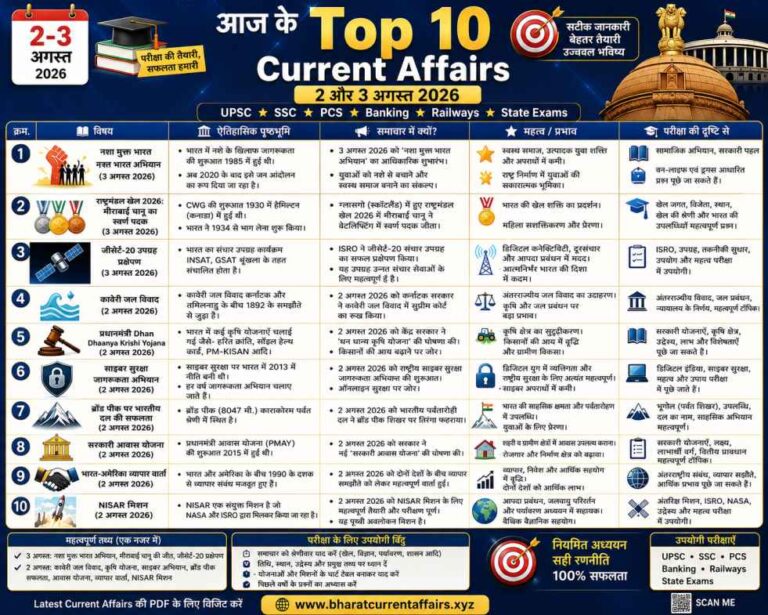
2-3 August 2026 Daily Current Affairs
2–3 अगस्त 2026 के Top 10 Current Affairs हिंदी में पढ़ें। UPSC, SSC, Banking, Railway, PCS व अन्य…
Read More →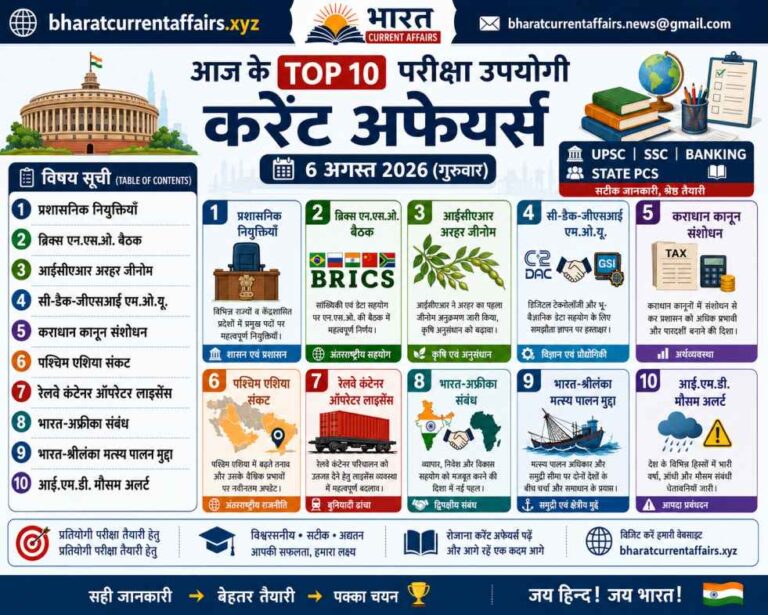
6 August 2026 Daily Current Affairs
Headline News for August 6, 2026: Key updates on new Cabinet Secretary TV Somanathan, BRICS NSO meeting, Critical…
Read More →
BRICS 2026: India Chairship, Members & Geopolitics
BRICS 2026 की India Chairship, 11 सदस्य, expansion, NDB, de-dollarisation, Global South और West Asia geopolitics की पूरी…
Read More →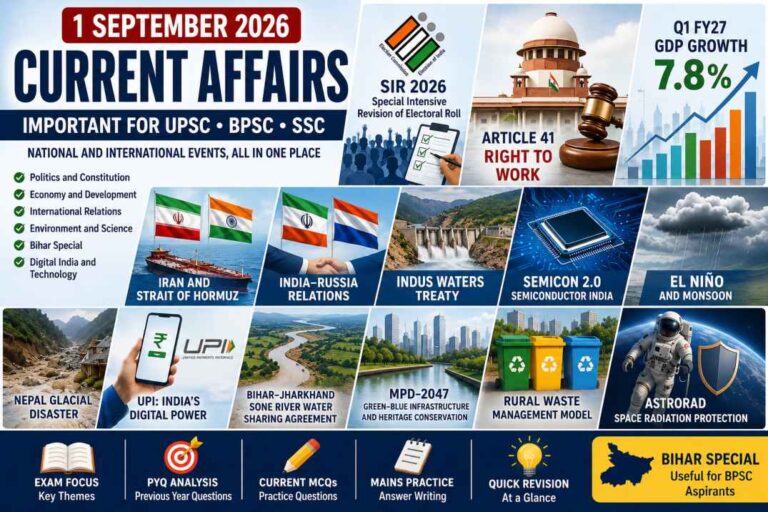
1 September 2026 Current Affairs: UPSC, BPSC & SSC
Read 1 September 2026 Current Affairs for UPSC, BPSC and SSC: SIR, GDP growth, Iran-Hormuz, IWT, Semicon 2.0,…
Read More →