Table of Contents
- 1. Top Administrative Service Extension (Appointments & Governance)
- 2. 18th BRICS National Statistical Offices Meeting (Global Economics)
- 3. Historical Breakthrough in Agricultural Science: ICAR T2T Genome (Science & Tech)
- 4. Strategic MoU Between C-DAC and GSI (Technology & Minerals)
- 5. Taxation Laws (Amendment) Bill 2026 Introduced in Parliament (Indian Economy)
- 6. West Asia Crisis & Strait of Hormuz (IR & Geopolitics)
- 7. Indian Railways’ New Freight Policy (Infrastructure & Policy)
- 8. India-Africa Relations: Africa Day & Knowledge Partnership (IR)
- 9. India-Sri Lanka Fishermen Issue & Maritime Boundary (Bilateral Relations)
- 10. Weather & Disaster Alert: IMD’s AI-Nowcasting System (Environment)
1. Top Administrative Extension: Cabinet Secretary T. V. Somanathan & Senior Bureaucrats Granted Tenure Extension
Historical Background
In India’s administrative setup, the Cabinet Secretary is the highest-ranking civil servant and ex-officio Chairman of the Civil Services Board. Historically, under Rule 56(a) of the ‘Fundamental Rules, 1922’, the retirement age for Central Government officers is set at 60 years. However, amendments under the All India Services (Death-cum-Retirement Benefits) Rules, 1958 and Fundamental Rule 56(d) grant special legal authority to the government to extend the service tenure of the Cabinet Secretary, Home Secretary, Foreign Secretary, Defence Secretary, and intelligence agency heads (RAW and IB) beyond retirement. This provision was added to ensure administrative continuity and prevent policy impasses during critical development phases.
Current Event Details
On August 6, 2026, the Appointments Committee of the Cabinet (ACC), chaired by the Prime Minister, formally approved a one-year tenure extension for India’s Cabinet Secretary T. V. Somanathan along with two other senior bureaucrats. A 1987-batch IAS officer of the Tamil Nadu cadre, T. V. Somanathan was granted this extension to maintain administrative stability and ensure smooth execution of key government schemes like PM Gati Shakti and Digital Governance initiatives.
Relevance to Current Affairs
Maintaining stability at top administrative posts is part of the Central Government’s long-term policy vision. Having previously served as Finance Secretary and Expenditure Secretary, T. V. Somanathan possesses vast financial and governance experience, which is considered vital for driving the economic roadmap of Viksit Bharat 2047.
- Incumbent Cabinet Secretary: T. V. Somanathan
- Chairman of ACC: Prime Minister of India
- Member of ACC: Union Minister of Home Affairs
- Cabinet Secretary Tenure: Can be extended up to a maximum of 4 years under Fundamental Rule 56(d).
Exam Relevance
UPSC / State PCS (GS Paper II – Governance & Polity):
- Powers, duties, and role of the Cabinet Secretary under Government of India (Allocation of Business) Rules, 1961.
- Composition and operational framework of the Appointments Committee of the Cabinet (ACC).
- Constitutional validity of Fundamental Rule 56(d) and stability vs. career progression issues in bureaucracy.
- Who is the current Cabinet Secretary of India? – T. V. Somanathan
- Who heads the Appointments Committee of the Cabinet? – Prime Minister
- What is the highest civil service post in India? – Cabinet Secretary
Significance & Importance
The tenure extension of T. V. Somanathan will reinforce Inter-Ministerial Coordination across departments, ensuring uninterrupted execution of major national infrastructure and fiscal policies.
2. 18th BRICS National Statistical Offices (NSOs) Meeting: Standardizing the Digital Economy
Historical Background
BRICS (comprising Brazil, Russia, India, China, South Africa, and recently expanded members Egypt, Ethiopia, Iran, Saudi Arabia, and UAE) represents a powerful bloc of emerging global economies. Since 2010, National Statistical Offices (NSOs) of BRICS countries have convened annually to publish the ‘BRICS Joint Statistical Publication’ (JSP). This publication serves as an official data benchmark for cross-country socioeconomic comparisons across member states.
Current Event Details, Venue & Chairmanship
The 18th Meeting of Heads of BRICS National Statistical Offices (NSOs) was hosted under India’s BRICS Chairship from August 3 to 4, 2026, at Lucknow, Uttar Pradesh, India. The inauguration and proceedings were chaired by Dr. Saurabh Garg, Secretary of the Ministry of Statistics and Programme Implementation (MoSPI) and Chair of the BRICS 2026 Statistics Track. The overarching theme was “Quality Statistics as Driver of Change”, focusing on digital economy measurement, leveraging Digital Public Infrastructure (DPI), and modernizing national statistical systems. During this meeting, India presented a statistical framework to measure the economic footprint of DPI innovations like UPI, Aadhaar, and ONDC.
Key BRICS Meetings & Events Held in India in 2026 (Place & Leadership)
| Date / Month | Meeting / Event Name | Venue / Location | Chairperson / Head / Organizer |
|---|---|---|---|
| 14–15 May 2026 | BRICS Foreign Ministers’ Meeting | Bharat Mandapam, New Delhi | Dr. S. Jaishankar (Union Minister of External Affairs) |
| 20–21 May 2026 | BRICS Track Event | Indore, Madhya Pradesh | MY Bharat / Youth Initiatives Delegation |
| 4–5 June 2026 | 2nd BRICS Culture Working Group Meeting | Varanasi, Uttar Pradesh | Shri Vivek Aggarwal (Secretary, Ministry of Culture) |
| 24 June 2026 | BRICS Youth Thematic Session 2026 | New Delhi | Ministry of Youth Affairs and Sports / MY Bharat |
| 3–4 August 2026 | 18th BRICS NSOs Heads Meeting | Lucknow, Uttar Pradesh | Dr. Saurabh Garg (Secretary, MoSPI) |
| 5–7 August 2026 | 13th BRICS Education Ministers’ Meeting | Bhubaneswar, Odisha | Shri Pralhad Joshi (Union Education Minister) |
| 5–6 August 2026 | 3rd BRICS Culture Working Group Meeting | Bhopal, Madhya Pradesh | Ministry of Culture Officials |
| 7–8 August 2026 | BRICS Culture Ministers’ Meeting | Bhopal, Madhya Pradesh | Gajendra Singh Shekhawat (Union Culture Minister) |
| 12–14 October 2026 | BRICS Theatre Festival | New Delhi | Ministry of Culture, Govt. of India |
Relevance to Current Affairs
With rapid economic diversification in the Global South, traditional GDP estimation methods are proving inadequate. Global consensus is building towards incorporating the gig economy, digital public networks, and green growth into national accounts. Aligning data standards across BRICS enables seamless trade and local currency settlement mechanisms.
Exam Relevance
UPSC / State PCS (GS Paper II & III – IR & Economy): BRICS expansion, digital economy measurement, and the structural role of MoSPI. SSC / Banking Exams: Venue of the 18th NSO meeting (Lucknow), Chair of BRICS Statistics Track (Dr. Saurabh Garg), and MoSPI Minister of State (Independent Charge) Rao Inderjit Singh.
Significance & Importance
Standardized data sharing will empower member countries to execute Local Currency Settlements and trade policies, reducing reliance on the US Dollar.
3. Historical Agricultural Breakthrough: ICAR Successfully Assembles Telomere-to-Telomere (T2T) Genome
Historical Background
Genome sequencing in crops provides crucial insights into biological traits like disease resistance, yield potential, and drought tolerance. Traditional Next-Generation Sequencing (NGS) left several gaps in complex genomic regions—especially repetitive telomeric zones. In agricultural science, building a completely gapless T2T genome for multi-chromosomal crops has long been a major technical challenge.
Current Event Details
On August 6, 2026, scientists at the ICAR-National Institute for Plant Biotechnology (NIPB) announced the successful completion of a 100% gapless ‘T2T Genome Assembly’ for one of India’s primary climate-resilient millet/cereal crops. This accomplishment fully maps complex genes that protect crops under extreme temperature, soil salinity, and water scarcity.
Relevance to Current Affairs
By using T2T genome-guided CRISPR-Cas9 gene editing, scientists can develop high-yielding, climate-adaptable crop varieties within just 2 to 3 years, safeguarding agricultural output against climate change.
Exam Relevance
UPSC / State PCS (GS Paper III – Science & Tech & Agriculture): T2T Genome Sequencing and applications of CRISPR-Cas9 in crop science. SSC / Banking Exams: Full form of ICAR, location of NIPB (New Delhi), and meaning of telomeres.
Significance & Importance
This research positions India at the forefront of global agri-biotechnology, ensuring long-term national food security towards 2047.
4. Strategic MoU Between C-DAC and GSI: Leveraging Supercomputing for Critical Minerals Exploration
Historical Background
The Geological Survey of India (GSI), established in 1851, is the nodal agency for geological assessments in the country. Meanwhile, C-DAC (Centre for Development of Advanced Computing) is India’s premier supercomputing organization under MeitY. Locating critical minerals—such as lithium, cobalt, and rare earth elements (REE) essential for EVs, solar panels, and defense systems—requires heavy computational data processing.
Current Event Details
On August 6, 2026, C-DAC and GSI signed a strategic MoU. Under this agreement, GSI’s vast aero-magnetic and seismic survey datasets will be analyzed using C-DAC’s AI-driven supercomputing platform, ‘PARAM Sanganak’, to pinpoint deep-seated critical mineral reserves across India.
Relevance to Current Affairs
This initiative aligns with India’s ‘National Critical Minerals Mission’ to reduce import dependence on foreign suppliers, particularly China, for critical raw materials.
Exam Relevance
UPSC / State PCS (GS Paper I & III – Geography & Science/Tech): Strategic importance of critical minerals and the National Supercomputing Mission (NSM). SSC / Banking Exams: Headquarters of GSI (Kolkata), establishment of C-DAC, and Union Minister of Mines.
Significance & Importance
Integrating AI with supercomputing reduces mineral exploration timelines from years to months, strengthening domestic industrial supply chains.
5. Taxation Laws (Amendment) Bill 2026 Introduced in Parliament: Major Fiscal Reforms
Historical Background
India’s Income Tax Act, 1961 has long been critiqued for its complexity and high litigation volume. Achieving a $5 trillion economy requires a transparent, simplified, and predictable tax structure to build investor confidence.
Current Event Details
On August 6, 2026, the Union Finance Minister introduced the Taxation Laws (Amendment) Bill, 2026 in the Lok Sabha. Key features include AI-driven automated dispute resolution for minor tax cases up to Rs 10 lakh, liberalized capital gains regulations for startups, and the decriminalization of minor procedural/clerical errors.
Relevance to Current Affairs
This bill represents a milestone toward enhancing ‘Tax Certainty’ and improving India’s global ‘Ease of Doing Business’ ranking.
Exam Relevance
UPSC / State PCS (GS II & III – Polity & Economy): Direct tax reforms and constitutional procedures governing Money Bills vs. Finance Bills. SSC / Banking Exams: Full form of CBDT, enactment year of Income Tax Act (1961), and Money Bill Article (110).
Significance & Importance
The legislation will significantly clear pending tax litigation, accelerating revenue collection and attracting Foreign Direct Investment (FDI).
6. West Asia Escalation: Tensions in the Strait of Hormuz and India’s ‘Operation Sankalp’
Historical Background
The Strait of Hormuz, located between Oman and Iran, links the Persian Gulf with the Gulf of Oman. It is the world’s most critical maritime oil transit choke point, handling roughly 20-21% of total global petroleum consumption.
Current Event Details
Amid escalating geopolitical friction in West Asia on August 6, 2026, the Indian Navy bolstered its operational presence under ‘Operation Sankalp’. Naval warships and P-8I maritime reconnaissance aircraft were deployed across the Gulf region to protect Indian-flagged merchant vessels.
Relevance to Current Affairs
India imports around 85% of its crude oil requirements, a huge portion of which passes through this maritime corridor. Any supply disruption risks driving domestic inflation and widening the Current Account Deficit (CAD).
Exam Relevance
UPSC / State PCS (GS Paper I & II – Geography & IR): Mapping global maritime choke points and India’s energy security framework. SSC / Banking Exams: Water bodies connected by the Strait of Hormuz and the objective of Operation Sankalp.
Significance & Importance
This deployment highlights the necessity for expanding India’s Strategic Petroleum Reserves (SPR) and preserving maritime safety in the Indian Ocean region.
7. Indian Railways’ Freight Modernization: Container Operators License Framework 2026
Historical Background
India’s overall logistics cost sits at around 13-14% of GDP. The National Logistics Policy aims to bring this down to global benchmarks (8-9%) while raising rail freight share from 27% to 45%.
Current Event Details
Indian Railways introduced key modifications to the Model Concession Agreement (MCA) for Container Train Operators (CTOs). Segmented routes have been replaced with a ‘Single All-India License’, allowing private operators to run container trains network-wide for 20 years at a uniform registration fee of Rs 25 crore.
Relevance to Current Affairs
This initiative directly supports the PM Gati Shakti National Master Plan aimed at streamlining freight transportation and lowering operational costs.
Exam Relevance
UPSC / State PCS (GS III – Infrastructure & Logistics): National Logistics Policy, PPP models in railways, and economic benefits of DFCs. SSC / Banking Exams: Registration fee for the new All-India License (Rs 25 Crore) and license duration (20 Years).
Significance & Importance
Greater private investment in container freight will reduce highway congestion, lower carbon emissions, and lower logistics overheads for exporters.
8. India-Africa Engagement: Launch of ‘India-Africa Knowledge Partnership Initiative’
Historical Background
India-Africa relations are rooted in the spirit of South-South Cooperation. Notably, India played a central role in securing permanent G20 membership for the African Union (AU) in 2023.
Current Event Details
In preparation for the 4th India-Africa Forum Summit (IAFS-IV), the Ministry of External Affairs launched the ‘India-Africa Knowledge Partnership Initiative’ centered on the theme “IA SPIRIT: Innovation, Resilience, and Inclusive Transformation”. India is extending its Digital Public Infrastructure (UPI, Aadhaar stack), green energy solutions, and 10,000 new educational scholarships to African nations.
Relevance to Current Affairs
India’s human-centric development partnership offers a sustainable alternative to debt-trap diplomacy in the Global South and Indian Ocean Rim.
Exam Relevance
UPSC / State PCS (GS Paper II – International Relations): India-Africa relations and strategic cooperation for UNSC reforms. SSC / Banking Exams: Headquarters of the African Union (Addis Ababa), theme of IAFS-IV, and full form of ITEC (Indian Technical and Economic Cooperation).
Significance & Importance
This initiative solidifies political alignment with 54 African votes supporting India’s bid for a permanent seat on the UN Security Council (UNSC).
9. India-Sri Lanka Maritime Issue: Dispute Over Palk Strait & Kachchatheevu Island
Historical Background
Under the 1974 and 1976 maritime agreements, Kachchatheevu Island was ceded to Sri Lanka. However, fishermen from Tamil Nadu regularly fish in traditional waters across the Palk Strait, leading to frequent detentions by the Sri Lankan Navy over maritime boundary violations.
Current Event Details
On August 6, 2026, during the Joint Working Group (JWG) meeting on Fisheries held in New Delhi, India urged Sri Lanka to immediately release detained Indian fishermen. Discussions highlighted transitioning fishermen away from destructive ‘Bottom Trawling’ toward ‘Deep-Sea Fishing’ supported by the PMMSY scheme.
Relevance to Current Affairs
Finding a humane solution to this issue is critical for coastal security and preserving diplomatic goodwill with neighbor Sri Lanka.
Exam Relevance
UPSC / State PCS (GS Paper II – Bilateral Relations): 1974/76 agreements, Kachchatheevu dispute, and environmental impacts of bottom trawling. SSC / Banking Exams: Location of Palk Strait and ministry responsible for PMMSY.
Significance & Importance
Equipping traditional fishermen with deep-sea fishing trawlers provides a sustainable resolution to border skirmishes.
10. Disaster Management: IMD Expands AI-Powered ‘Urban Nowcasting System’
Historical Background
The India Meteorological Department (IMD), established in 1875, is the nodal agency under the Ministry of Earth Sciences. Standard forecast models provide 24-48 hour district-level updates, which are insufficient for hyper-local flash floods and sudden cloudburst events.
Current Event Details
On August 6, 2026, IMD expanded its high-resolution (300-meter) AI-driven ‘Urban Nowcasting System’ across major metropolitan cities. Integrating Doppler radar networks, satellite feeds, and machine learning, the system provides ward-level alerts for intense rainfall and urban flooding within a 0 to 3-hour window (Nowcast).
Relevance to Current Affairs
As climate change worsens urban flooding, this real-time AI alert system gives NDRF/SDRF disaster response teams actionable lead time to protect lives and infrastructure.
Exam Relevance
UPSC / State PCS (GS Paper III – Environment & Disaster Management): Urban flooding, Early Warning Systems (EWS), and AI applications in disaster mitigation. SSC / Banking Exams: IMD establishment year (1875), nowcasting timeframe (0-3 hours), and official ‘Mausam’ App.
Significance & Importance
Ward-level early warnings minimize loss of life and property while enabling municipal authorities to divert traffic and manage drainage dynamically.
Today’s Top 10 Practice MCQs
Official External Resources & References
Aspirants can refer to the following official government portals for verified information:
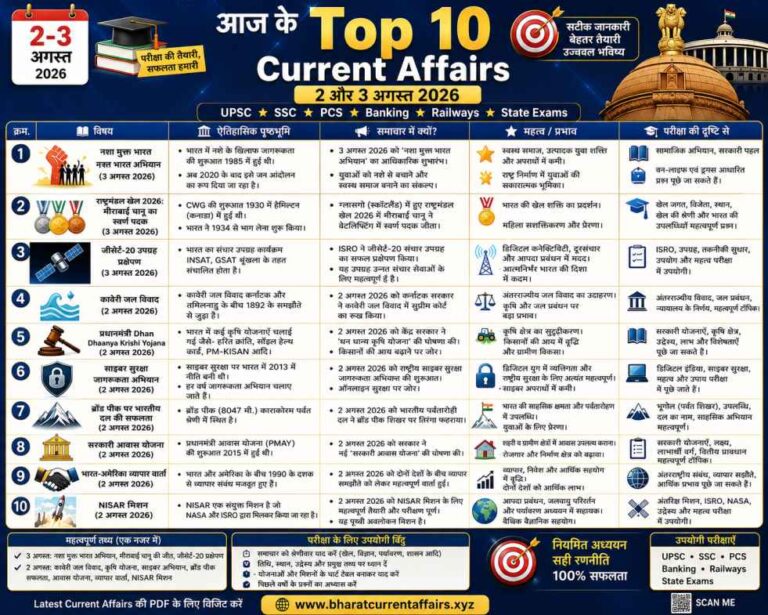
2-3 August 2026 Daily Current Affairs
2–3 अगस्त 2026 के Top 10 Current Affairs हिंदी में पढ़ें। UPSC, SSC, Banking, Railway, PCS व अन्य…
Read More →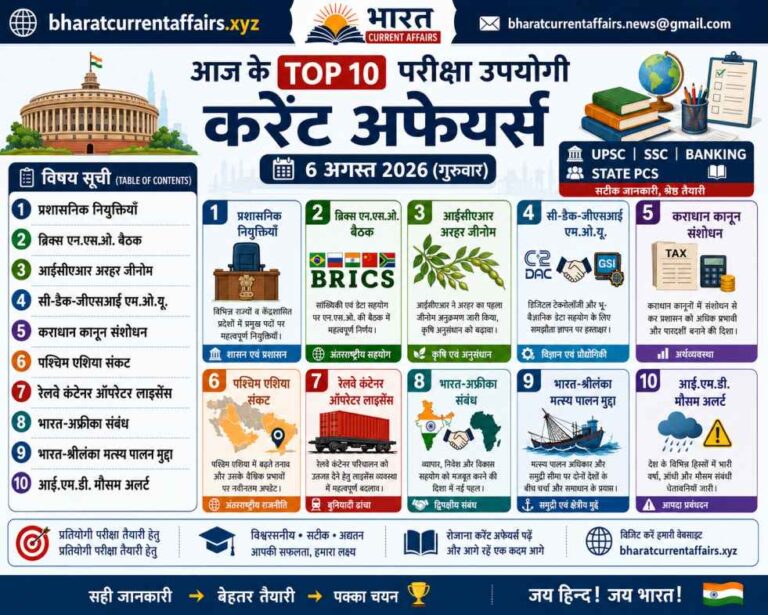
6 August 2026 Daily Current Affairs
Headline News for August 6, 2026: Key updates on new Cabinet Secretary TV Somanathan, BRICS NSO meeting, Critical…
Read More →
BRICS 2026: India Chairship, Members & Geopolitics
BRICS 2026 की India Chairship, 11 सदस्य, expansion, NDB, de-dollarisation, Global South और West Asia geopolitics की पूरी…
Read More →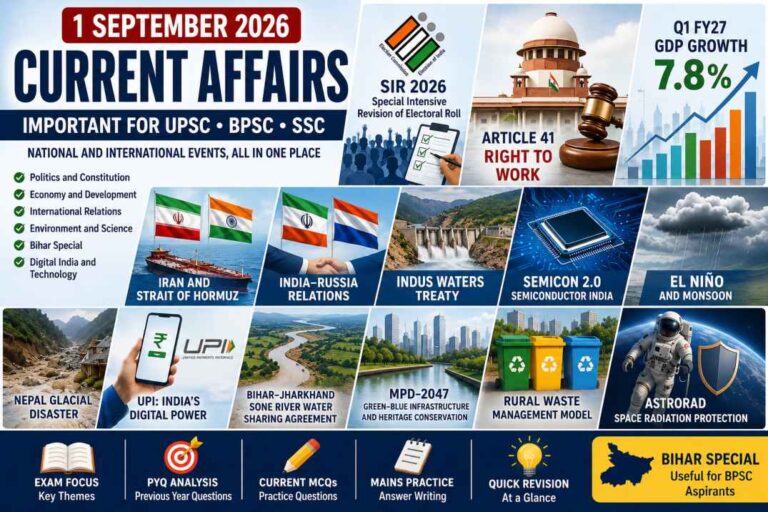
1 September 2026 Current Affairs: UPSC, BPSC & SSC
Read 1 September 2026 Current Affairs for UPSC, BPSC and SSC: SIR, GDP growth, Iran-Hormuz, IWT, Semicon 2.0,…
Read More →