Portal: Bharat Current Affairs
Editorial Analysis: The Hindu & The Indian Express
Below is an in-depth, factual, and exam-oriented analytical presentation of the top 10 current affairs issues for 14 August 2026, specially prepared for aspirants preparing for prestigious competitive examinations such as Union Public Service Commission (UPSC CSE), State Public Service Commissions (State PCS – UPPSC, BPSC, MPPSC, RAS), SSC, and Banking.
📌 Table of Contents
- FCRA Amendment Bill, 2026 Referred to Joint Parliamentary Committee (JPC)
- Independence Day 2026: Ministry of Home Affairs Announces 1,057 Medals
- Supreme Court Notice to FSSAI on Front-of-Pack Warning Labels (FOPL)
- US Crackdown on Tariff Evasion: India Named in 40-Nation Report
- CAG Report: Reveals Cost Overestimation and Unrealistic Rates in CPWD
- Public Examination (Prevention of Unfair Means) Amendment Bill, 2026 Passed
- Chamoli Hydroelectric Tunnel Accident & Himalayan Ecological Fragility
- Karnataka Public Space Regulation Bill, 2026 Passed
- Global Crude Oil Volatility & US-Iran Tension in the Persian Gulf (Deep Analysis)
- Bar Council of India (BCI) Directive on Enrollment of NALSAR Law Graduates
- 📝 10 Complete Exam Practice MCQs
- 🔗 Official Resources & External Links
1. FCRA Amendment Bill, 2026 Referred to Joint Parliamentary Committee (JPC)
Following heavy opposition from the opposition and Civil Society Organizations (NGOs) on the final day of the Monsoon Session of Parliament, the Central Government referred the Foreign Contribution (Regulation) Amendment Bill, 2026 [FCRA Amendment Bill, 2026] to a 31-member Joint Parliamentary Committee (JPC).
The Foreign Contribution (Regulation) Act (FCRA) was originally enacted in 1976 during the Emergency to prevent the improper influence of foreign funds in national interests. In 2010, it was repealed and replaced by the new FCRA 2010 Act, which underwent stringent amendments again in 2020. The 2020 amendments made it mandatory for non-governmental organizations to open FCRA accounts strictly at the SBI Main Branch in New Delhi and reduced the cap on administrative expenses from 50% to 20%.
The proposed 2026 amendment bill contains very stringent provisions, including the retrospective vesting (seizure/acquisition of property with retrospective effect) of foreign-funded assets and the transfer of related assets to a government trust upon cancellation of an FCRA license. In the 31-member JPC, 21 members have been nominated from the Lok Sabha and 10 members from the Rajya Sabha, which will submit its report in the upcoming session.
This move directly impacts the operations of civil society organizations, human rights groups, and relationships with international donors in India. The government argues that this ensures national security and transparent foreign funding, while critics believe it could restrict the space for democratic dissent.
- Parliamentary Procedure: Composition, powers, and functioning of a JPC (Ad-hoc Committee vs. Standing Committee).
- Constitution & Governance: Article 19(1)(c) of the Constitution – Right to form associations or unions and reasonable restrictions on it.
2. Independence Day 2026: MHA Announces 1,057 Medals
On the occasion of the 79th Independence Day 2026, the Ministry of Home Affairs (MHA) announced a total of 1,057 medals for security personnel from police, fire services, home guards, and correctional services.
Out of the total announced medals, 301 Medals for Gallantry (GM) are included. According to regional distribution:
- 197 Gallantry Medals: Awarded for specialized operations in Left Wing Extremism (LWE) or Naxal-affected areas (Chhattisgarh, Jharkhand, Odisha).
- 51 Gallantry Medals: Conferred for counter-terrorism operations in the Union Territory of Jammu & Kashmir.
- The remaining medals were awarded to personnel from northeastern states and other states/Central Armed Police Forces (CAPFs).
This high number of medals in areas affected by Left Wing Extremism underlines the Government of India’s resolve to completely eradicate Naxalism by 2026. This boosts the morale of police forces and strengthens governance penetration in affected regions.
- Internal Security: Geography of Left Wing Extremism, its causes, and mitigation strategy.
- MHA Medal Structure: Restructuring of Medal for Gallantry (GM), President’s Medal for Distinguished Service (PSM), and Medal for Meritorious Service (MSM).
3. Supreme Court Notice to FSSAI on Front-of-Pack Warning Labels (FOPL)
A bench of the Supreme Court issued a show-cause notice to the Food Safety and Standards Authority of India (FSSAI) seeking a response within 2 weeks on why there has been a delay in making Front-of-Pack Warning Labels (FOPL) mandatory on packaged food products.
FSSAI was established under the Food Safety and Standards Act, 2006 under the Ministry of Health and Family Welfare. Since 2019, a proposal to introduce warning labels on foods containing High Fat, Sugar, and Salt (HFSS) has been under consideration in India.
The Supreme Court clarified that clear and direct color-coded warning labels are significantly more effective compared to industry-friendly ‘Health Star Ratings’ (HSR). Countries such as Chile, Mexico, and Brazil have recorded a sharp reduction in packaged food consumption after implementing red warning blocks.
- Article 21: Right to Life (Right to Health and Safe Food).
- Regulatory Challenges: Corporate pressure vs. consumer rights (Consumer Protection Act 2019).
4. US Crackdown on Tariff Evasion: India Named in 40-Nation Report
The US Department of Commerce named over 40 countries, including India, in its latest global trade investigation report. The report alleges that high import tariffs imposed by the US on Chinese goods are being evaded through re-routing/transshipment via these third countries.
The primary focus of the US report is on the violation of Rules of Origin (RoO). According to the report, Chinese textiles, steel, and electronic components are brought into third countries like India with minimal value addition, masked, and subsequently exported to US markets.
This report could increase diplomatic pressure on India-US bilateral trade negotiations. If the United States Trade Representative (USTR) initiates Section 301 or anti-dumping investigations against India, Indian pharmaceutical, textile, and engineering exports could be affected.
- International Trade: WTO Rules of Origin laws and subsidy provisions.
- India-US Relations: Trade friction, GSP status, and supply chain re-alignment.
5. CAG Highlights Cost Overestimation & Unrealistic Rates in CPWD
The Comptroller and Auditor General of India (CAG) tabled a comprehensive audit report in Parliament examining the performance of civil and infrastructure projects of the Central Public Works Department (CPWD).
The CAG is an independent constitutional authority under Articles 148 to 151 of the Constitution of India. It ensures financial accountability to Parliament by auditing the public accounts, contingency funds, and public sector undertakings of the Union and States.
The CAG report highlighted the following serious irregularities:
- Base rates in 93% of audited projects were found to be unrealistic and excessively high.
- An total excess fund drawal of ₹513 crore was observed due to financial irregularities in project estimations.
- Increases in CPWD’s ‘Schedule of Rates’ (SoR) were carried out without scientific market rate studies.
- Constitutional Provisions: Article 149 (Duties and powers of CAG), analysis of CAG reports by the Public Accounts Committee (PAC).
- Public Procurement Reforms: GFR (General Financial Rules) 2017 and CVC’s transparent tendering guidelines.
6. Public Examination (Prevention of Unfair Means) Amendment Bill, 2026 Passed
Both Houses of Parliament passed the Public Examination (Prevention of Unfair Means) Amendment Bill, 2026 to completely eliminate paper leaks, cheating, and organized syndicates in competitive examinations.
Under this amended Act, paper leak offences have been classified under non-bailable and cognizable categories:
- Imprisonment: Provision of 5 to 10 years of rigorous imprisonment for organized crime syndicates and paper leak perpetrators.
- Monetary Penalty: Fines of up to ₹10 crore on guilty coaching institutes or organized groups and attachment of their properties.
- Crackdown on Service Providers: If any outsourced examination agency or computer lab is found involved in malpractices, a 10-year ban will be imposed on it.
- Administrative Law: Transparency in public recruitment systems, structural review of NTA.
- Youth Welfare & Governance: Administrative Reforms Commission (ARC) recommendations on fair examinations.
7. Chamoli Hydroelectric Tunnel Disaster & Himalayan Eco-Fragility
A major accident occurred when silt (debris) and water suddenly flooded a tunnel of an under-construction hydroelectric project in the Alaknanda river basin in the Pipalkoti area of Chamoli district, Uttarakhand. This incident has once again highlighted the environmental hazards of large infrastructure construction in the Central Himalayan region.
Chamoli district in Uttarakhand falls under the highly sensitive Seismic Zone V. This region is situated near the Main Central Thrust (MCT), where geological structures are extremely fragile and slopes are unstable. Following the 2013 Kedarnath tragedy and the 2021 Tapovan-Vishnugad disaster, this is the third major event in this region.
Expert committees constituted by the National Disaster Management Authority (NDMA) and the High Court recommended that the Cumulative Environmental Impact Assessment (EIA) of Run-of-the-River projects situated in sensitive Himalayan valleys at altitudes above 2,000 meters be strictly evaluated.
- Environmental Impact Assessment (EIA): EIA Notification 2006, Himalayan development vs. conservation debate.
- Disaster Management: Sendai Framework and NDMA guidelines for disaster management in hilly areas.
8. Karnataka Public Space Regulation Bill, 2026
The Karnataka State Legislative Assembly passed the Karnataka Public Space Regulation Bill, 2026 to regulate rallies, marches, and political protests in public places, roads, and parks. This step follows recent controversies over RSS marches and various political protests.
Article 19(1)(b) of the Indian Constitution grants citizens the right to “assemble peaceably and without arms.” However, under Article 19(3), state governments have the power to impose reasonable restrictions on this right in the interests of ‘Public Order’ and the ‘Sovereignty and Integrity of India.’ According to the 7th Schedule of the Constitution, ‘Public Order’ and ‘Police’ are subjects under the State List.
In the Shaheen Bagh case (2020), the Supreme Court held that while the right to protest is fundamental, blocking public roads indefinitely violates the fundamental right to movement of other citizens (Article 19(1)(d)).
- Fundamental Rights: Freedoms under Article 19 and restrictions on them.
- Separation of Powers: Legislative powers of the State Legislature and Judicial Review.
9. Global Crude Oil Volatility & US-Iran Persian Gulf Standoff
Severe turmoil is being witnessed in the global energy market due to escalating military tensions between the US and Iran in the Persian Gulf and the strategically critical Strait of Hormuz. Brent Crude Oil rates in the international market crossed recent highs of $87 per barrel. As a direct result, Indian stock markets (Sensex and Nifty) experienced sharp declines, and the Indian Rupee (INR) faced historical pressure against the US Dollar, reaching ₹95.40/USD.
The Strait of Hormuz connects the Persian Gulf with the Gulf of Oman and the Arabian Sea. It is the world’s most critical oil transit chokepoint:
- Global Oil Flow: Approximately 20% of global seaborne crude oil transport (around 21 million barrels per day) passes through this narrow waterway.
- LNG Supply: A major portion of global Liquefied Natural Gas (LNG) exported by Qatar reaches India and Asian countries through this route.
- Military Standoff: Increased naval patrolling by the US and threats of tanker blockades by Iran have raised war risk insurance premiums, making freight rates significantly more expensive.
📉 1. Current Account Deficit (CAD)
An increase of $10/barrel in crude oil prices increases India’s Current Account Deficit (CAD) by approximately $14-15 billion.
💸 2. Imported Inflation
Higher fuel costs make logistics and freight more expensive, placing upward pressure on Consumer Price Index (CPI) retail inflation.
🏦 3. Rupee and Foreign Exchange Reserves
High demand for dollars by oil importers depreciates the Rupee, forcing the RBI to sell dollars to stabilize the currency.
- GS Paper III (Economy): Macroeconomic stability, import dependence, foreign exchange reserve management, and inflation dynamics.
- GS Paper II (International Relations): Geopolitics of West Asia, India’s ‘Look West’ policy, and energy diplomacy.
10. Bar Council of India (BCI) Directive on NALSAR Law Graduates
The Bar Council of India (BCI) withdrew a controversial order within hours of issuing it, which had put a stay on the provisional enrollment of the 2026 batch graduates of India’s premier national law university – NALSAR University of Law (Hyderabad) – in State Bar Councils.
The Bar Council of India (BCI) is a statutory body established under the Advocates Act, 1961. It is the apex body regulating standards of legal education and setting professional conduct and enrollment guidelines for advocates in India.
This dispute arose over a jurisdictional clash between autonomous curriculum and credit structure modifications made by NALSAR and BCI’s Legal Education Rules. Although BCI withdrew its stay order following swift administrative discussions, the incident sparked a debate over relationships between autonomous National Law Universities (NLUs) and central regulatory bodies.
- Constitutional & Statutory Bodies: Legal powers of BCI and the framework of the Advocates Act, 1961.
- Higher Education Reforms: Institutional autonomy and integrated regulation under the National Education Policy (NEP 2020).
📝 10 Practice MCQs with Detailed Explanations
Objective questions based on today’s top 10 current affairs issues (UPSC, State PCS, SSC, and Banking patterns):
🔗 Official Resources & External Links
Visit the links below to access official reports and verified information:
- Ministry of Home Affairs (MHA Official) – Independence Day Medal List
- FSSAI – Food Safety and Standards Authority of India – FOPL Regulations
- CAG India (Comptroller & Auditor General) – CPWD Audit Report 2026
- Parliament of India Portal – FCRA & Public Exam Bills
- Bar Council of India (BCI Official) – Legal Education Guidelines
© 2026 Bharat Current Affairs (bharatcurrentaffairs.xyz). All rights reserved. Analytical content curated specifically for competitive examinations.
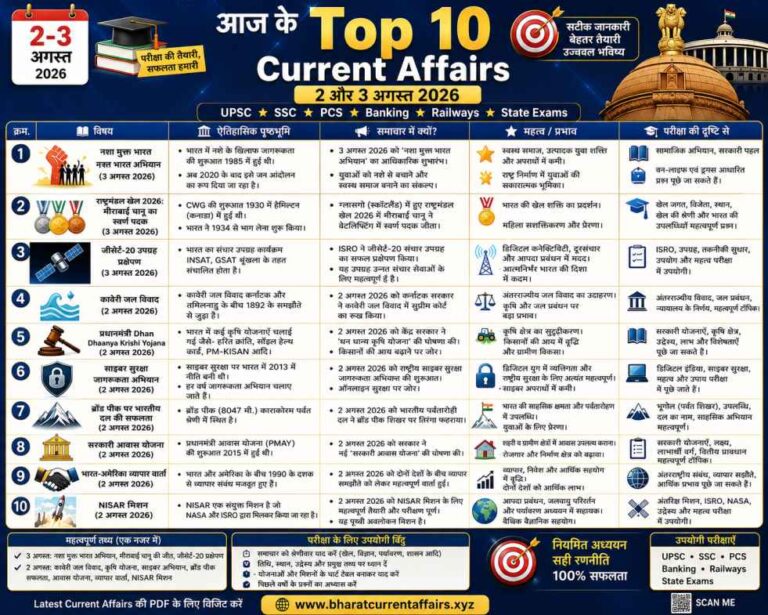
2-3 August 2026 Daily Current Affairs
2–3 अगस्त 2026 के Top 10 Current Affairs हिंदी में पढ़ें। UPSC, SSC, Banking, Railway, PCS व अन्य…
Read More →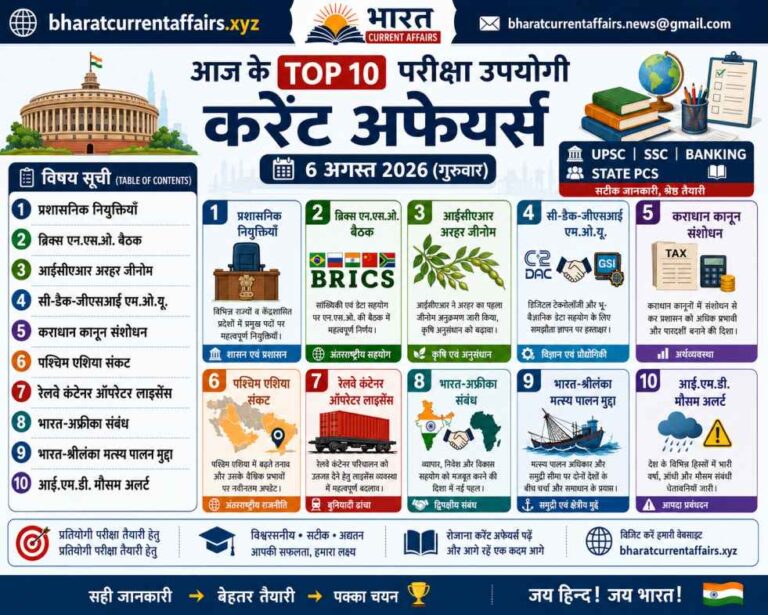
6 August 2026 Daily Current Affairs
Headline News for August 6, 2026: Key updates on new Cabinet Secretary TV Somanathan, BRICS NSO meeting, Critical…
Read More →
BRICS 2026: India Chairship, Members & Geopolitics
BRICS 2026 की India Chairship, 11 सदस्य, expansion, NDB, de-dollarisation, Global South और West Asia geopolitics की पूरी…
Read More →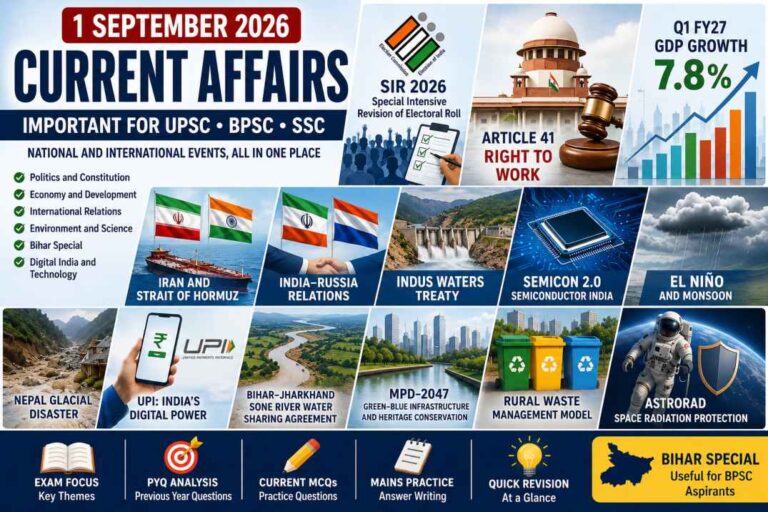
1 September 2026 Current Affairs: UPSC, BPSC & SSC
Read 1 September 2026 Current Affairs for UPSC, BPSC and SSC: SIR, GDP growth, Iran-Hormuz, IWT, Semicon 2.0,…
Read More →