September 5, 2026 Current Affairs in English: The Hindu & Indian Express Newspaper Analysis
A comprehensive daily current affairs class based on News + Background + Static GK + Exam Link + PYQs for UPSC, BPSC, SSC, RRB, Banking, CDS, CAPF and NDA
🎯 Exam Focus: Which Topics Should You Focus on Most Today?
Both newspapers covered several events today, but from an examination perspective, the highest-value issues are those where Current News + Static Concept + Governance/Policy + International Relations are interconnected.
📖 Introduction: Do Not Just Read the Newspaper — Understand It
Both the The Hindu and The Indian Express editions dated September 5, 2026 featured several issues related to technology, judiciary, economy, international relations, disaster management, education, security, sports and awards. The publication date of both newspapers is independently verified from their mastheads as Saturday, September 5, 2026; therefore, this is a consolidated daily current affairs class.
The most important learning from today is that a single news story can open up multiple examination dimensions. For example, EOS-05 is not merely a satellite launch; it can be used to study geosynchronous orbit, earth observation, remote sensing, GSLV and strategic applications. Similarly, Article 142 is not merely a power of the Supreme Court; it can be used to understand judicial review, separation of powers, complete justice and judicial overreach.
With this approach, the news below is explained in the sequence of what happened → what it is → background → why it is important now → static concept → impact → exam relevance.
📚 Table of Contents
1. ISRO’s EOS-05: Advanced Earth Observation Satellite Launched by GSLV-F17
ISRO successfully launched the 2,367-kilogram EOS-05 through GSLV-F17. The satellite was placed into the intended Sub-Geosynchronous Transfer Orbit approximately 18 minutes after launch. This was reported as the 19th GSLV flight and the 107th launch from Sriharikota.
Let Us Understand This in Simple Language First
An Earth Observation Satellite is a satellite that provides imagery/data about the Earth’s surface, atmosphere, oceans, agriculture, forests, water resources or disaster situations. The special feature of EOS-05 is that it has been designed for Earth monitoring from a geosynchronous orbit at an altitude of approximately 36,000 km.
What is a Geosynchronous Orbit?
In a geosynchronous orbit, the satellite’s orbital period is equal to the Earth’s rotation period. If the orbit is equatorial and circular and the satellite moves in the correct direction along with Earth’s rotation, it is called geostationary and appears to remain fixed over approximately the same region when viewed from Earth.
Why is it in the News Now?
The successful launch of EOS-05 is particularly important for ISRO because the PSLV-C62/EOS-N1 mission had failed in January 2026 and the PSLV-C61 mission had faced failure in May 2025. Therefore, the success of GSLV-F17 provided important relief in terms of launch reliability and mission confidence.
Major Uses of EOS-05
| Sector | Potential Use |
|---|---|
| Agriculture | Crop monitoring and land-use assessment |
| Environment | Monitoring forests, water resources and ecological changes |
| Disaster Management | Imagery of floods, disasters and affected areas |
| Strategic Applications | Important real-time geospatial information |
Exam Perspective
- Difference between GSLV and PSLV.
- Geosynchronous versus Geostationary orbit.
- Applications of Earth Observation Satellites.
- Relationship between Launch Vehicle and payload capability.
- Linkage between remote sensing and disaster management.
Verified PYQ Audit
No verified Previous Year Government Exam Question directly related to this specific EOS-05 mission was found. However, satellite technology and space science are regularly asked areas in UPSC and other examinations.
2. Air India Dismisses Delhi–Phuket Flight Pilot: Importance of the AAIB Report
What happened? A Delhi–Phuket flight on August 4 briefly lost altitude and 24 passengers were injured. The AAIB preliminary report mentioned a non-negative result for a psychoactive substance in the confirmatory test of the pilot-in-command and recommended priority action by the DGCA. Air India subsequently dismissed the pilot.
Understanding the Technical Incident
According to the report, during the incident, all three hydraulic systems of the aircraft failed, the autopilot disengaged and a stall warning occurred for approximately two seconds. The aircraft first gained 372 feet and then descended 292 feet in relation to the assigned Flight Level 360. The hydraulic systems recovered after which flight operations returned to normal.
Why is this Incident Not Merely a Matter of Pilot Discipline?
This is a multi-layered aviation safety case. It involves human factors, medical fitness, cockpit procedures, aircraft systems, hydraulic redundancy, autopilot, turbulence/altitude events, passenger safety and regulatory oversight. It is also important to understand the difference between a preliminary report and a final investigation. According to the newspaper report, the final report may take a year or more.
| Stakeholder | Role |
|---|---|
| AAIB | Aircraft accident/incident investigation |
| DGCA | Civil aviation safety and regulatory oversight |
| Airline | Operational and personnel safety compliance |
| Pilot/Crew | Safe operation and emergency response |
Exam Perspective
Functions of AAIB and DGCA, aviation safety regulation, human factors, aircraft hydraulic systems, and preliminary versus final investigation are exam-worthy concepts.
Verified PYQ Audit
No verified Previous Year Government Exam Question directly related to this specific Air India incident was found.
3. GDP Growth 7.8%: Understand Strong Growth Alongside the Jobs–Inflation Debate
What happened? Real GDP growth in the first quarter of FY 2026-27, i.e. April–June 2026, was recorded at 7.8%. The newspapers also highlighted a political and analytical debate regarding the credibility of this figure, jobs and people’s actual economic experience.
What is GDP?
Gross Domestic Product (GDP) is a measure of the monetary value of final goods and services produced within a country’s domestic territory during a given period. GDP growth indicates how rapidly economic output has increased or decreased compared with the previous comparable period.
Real GDP vs Nominal GDP
| Concept | Meaning | Why Important? |
|---|---|---|
| Real GDP | Output at constant prices | A better indicator of actual growth by removing the effect of price changes |
| Nominal GDP | Output at current prices | Includes the effect of both output and prices |
| GVA | Value added by production sectors | Useful for understanding sector-wise economic performance |
Now the Question is: Why is the Jobs Question Being Raised Despite 7.8% Growth?
GDP is an aggregate measure of output. It does not by itself tell us how much each household’s income has increased, how much employment has grown, or how regional inequality has changed. Therefore, GDP growth ≠ automatically inclusive growth.
The newspaper discussion highlights the need to examine GDP data together with consumer sentiment, employment and inflation. This distinction is very important in a Mains answer: look at the quality and distribution of growth along with its quantity.
Current + Static Link
The new GDP series uses 2022-23 as the base year. Therefore, while studying current GDP numbers, it is necessary to understand changes in the base year and methodology. Statistical revision should not immediately be considered manipulation; methodology, updated data sources and the revision cycle should be examined.
Exam Perspective
- Difference between GDP and GVA.
- Real GDP and nominal GDP.
- Difference between GDP deflator and CPI.
- Relationship between growth, employment and inclusive development.
- Base year and national accounts revision.
Verified PYQ Audit
No verified Previous Year Government Exam Question directly related to this 2026 Q1 GDP release was found. However, older questions on GDP and national income concepts do exist, so static macroeconomics should definitely be revised.
4. Article 142: Supreme Court’s ‘Complete Justice’ Power and 5.18 Crore Pending Cases
The Indian Express gave prominence to the debated role of the Supreme Court under Article 142, while The Hindu reported the Supreme Court’s concern regarding the need to increase the retirement age of judicial officers in the context of pending cases in the district judiciary.
What is Article 142?
Article 142 of the Constitution gives the Supreme Court the power to pass any decree or order necessary for doing “complete justice” in any pending cause or matter. A decree/order passed by the Supreme Court under this provision is enforceable throughout India, within the prescribed constitutional/legal framework.
Article 142 vs Article 136
| Article | Core Idea |
|---|---|
| 136 | Special Leave to Appeal jurisdiction of the Supreme Court |
| 142 | Necessary decree/order for complete justice in a pending matter |
| 32 | Right to approach the Supreme Court for enforcement of Fundamental Rights |
Why is Judicial Backlog Important?
According to The Hindu, approximately 5.18 crore cases were reported as pending in district courts. The Supreme Court asked States to decide on increasing the retirement age of judicial officers from 60 to 62 years. Seven States had responded positively, while other States were hesitant due to financial and parity concerns.
The Supreme Court’s argument was that retaining experienced judicial officers could strengthen adjudicatory capacity while preserving existing expertise alongside new judicial appointments. However, it is necessary to safeguard suitability assessment and judicial quality.
Key Debate Around Article 142
- Advantage: Helps achieve complete justice when the existing legal remedy is inadequate.
- Concern: Excessive discretion may create a debate over judicial overreach.
- Constitutional principle: Respect for separation of powers is essential.
- Exam point: Article 142 is a power of the Supreme Court; do not confuse it with an identical constitutional power of the High Courts.
Verified PYQ Audit
Question: With reference to the Constitution of India, prohibitions or limitations or provisions contained in ordinary laws cannot act as prohibitions or limitations on the constitutional powers under Article 142. It could mean which one of the following?
- The decisions taken by the Election Commission of India while discharging its duties cannot be challenged in any court of law.
- The Supreme Court of India is not constrained in the exercise of its powers by laws made by the Parliament.
- In the event of grave financial crisis in the country, the President of India can declare Financial Emergency without the counsel from the Cabinet.
- State legislatures cannot make laws on certain matters without the concurrence of Union Legislature.
Correct Answer: B
Conceptual Explanation: This question tests the relationship between the extraordinary constitutional power under Article 142 and ordinary statutory limitations.
5. SIR, NRC and Census: The Question of Identity in the Context of Manipur and Arunachal Pradesh
The Indian Express Explained page explained the ethnic fault-lines, demographic displacement and Census-related concerns behind the demand for NRC in Manipur. The Hindu also prominently reported violence related to the inclusion of Chakma and Hajong communities in the electoral-roll Special Intensive Revision in Arunachal Pradesh.
What is SIR?
Special Intensive Revision (SIR) is an intensive revision exercise of electoral rolls in which electoral rolls are verified and updated more comprehensively. Its objective is to include eligible voters and remove ineligible, deceased, shifted or duplicate entries.
What is NRC?
National Register of Citizens (NRC) is a register of citizens. It is incorrect to consider an electoral roll and a citizenship register as the same thing. The purpose of a voter list is to determine electoral eligibility, while a citizenship register relates to citizenship status.
How is it Related to the Census?
Census is a statistical enumeration of demographic and socio-economic characteristics of the population. NRC is a citizenship-oriented register and electoral rolls are related to voting eligibility. Therefore, although the purposes of all three datasets are different, conceptual linkages can emerge at the level of migration, identity, population composition and public policy.
Chakma–Hajong Issue in Arunachal Pradesh
According to The Hindu, violence occurred in the Bordumsa area of Changlang district, Arunachal Pradesh, during the SIR exercise over the alleged inclusion of the Chakma and Hajong communities. For the exam, study this in the context of tribal identity, migration, electoral rolls and constitutional protection.
Why is There a Demand for NRC in Manipur?
The Indian Express Explained linked the demand for NRC with demographic change and ethnic insecurity. In such cases, policy responses face two equally important objectives—legal identity verification and constitutional protection of legitimate residents/citizens.
Exam Perspective
- Article 324 and the constitutional role of the Election Commission.
- Representation of the People Act and electoral rolls.
- Census versus NRC versus electoral roll.
- Difference between citizenship and voting rights.
- Context of ethnicity, migration and Sixth Schedule/autonomous institutions in the North-East.
Verified PYQ Audit
No verified Previous Year Government Exam Question directly related to this specific 2026 SIR/NRC development was found.
6. India’s Strategic Diplomacy: China, Ukraine and India–EU Economic Engagement
India–China Corps Commanders’ Meeting
The Indian Express front page and second page highlighted India-China military dialogue. The purpose of Corps Commander-level talks is to manage border-related military tensions, maintain communication channels and support stability at the field level.
India–Ukraine–Russia
External Affairs Minister S. Jaishankar said that India is in contact with both the Ukrainian and Russian sides and is trying to find ideas that could contribute to conflict mitigation or cessation. This can be studied in the context of India’s traditional strategic autonomy and dialogue-oriented diplomacy.
India–EU FTA and Belgium
The Hindu discussed Belgian Prime Minister Bart De Wever’s presentation of the Port of Antwerp-Bruges as a gateway for Indian exports and the economic opportunities associated with the India–EU Free Trade Agreement. According to the newspaper, once the agreement comes into effect, it could have an expected impact of reducing/eliminating tariffs on a large share of Indian and European goods exports.
This issue is not merely about trade for India. It should be linked with market access, logistics, supply-chain resilience, pharmaceuticals, food processing, green hydrogen, infrastructure and gems & jewellery.
Giorgia Meloni’s Record in Italy
The Hindu reported that Giorgia Meloni became the longest continuously serving Prime Minister of post-war Italy. The bilateral relationship was also covered in the context of the India–Italy Special Strategic Partnership and the India-West Asia-Europe Economic Corridor.
Verified PYQ Audit
No verified Previous Year Government Exam Question directly related to these specific September 2026 diplomatic developments was found.
7. Houthi Offensive in Yemen and Bab el-Mandeb: A Strategic Chokepoint of Global Trade
The Hindu reported renewed clashes between the Houthis and government forces in Yemen. According to the newspaper, a tally of at least 129 deaths was reported and the Houthi offensive aimed to strengthen strategic positions near the Red Sea gateway.
What is Bab el-Mandeb?
Bab el-Mandeb Strait connects the Red Sea with the Gulf of Aden. It is a strategic maritime chokepoint located between Yemen on the Arabian Peninsula and the Djibouti/Eritrea region of the Horn of Africa.
Why is a Chokepoint Important?
A maritime chokepoint is a narrow sea route through which a large volume of global shipping passes. Conflict or blockade at such a chokepoint can lengthen shipping routes, increase insurance and freight costs, and affect energy prices.
Map-based Static GK
| Route | Connection |
|---|---|
| Strait of Hormuz | Persian Gulf ↔ Gulf of Oman |
| Bab el-Mandeb | Red Sea ↔ Gulf of Aden |
| Suez Canal | Mediterranean Sea ↔ Red Sea |
| Malacca Strait | Andaman Sea/Indian Ocean side ↔ South China Sea |
Connection with UNCLOS
In a Hindu interview, Ramon Magsaysay Award winner Tommy Koh described UNCLOS as the “constitution” of the oceans. UNCLOS provides a framework for maritime zones, navigation rights, EEZ, continental shelf and several maritime legal principles.
Here, an important distinction is that geopolitical control and legal navigation rights are not the same thing. The military-control situation around a strait may change, but international maritime law creates separate legal questions and principles.
Importance for India
- Indian Ocean maritime security.
- Energy imports and global oil trade.
- India-Europe shipping routes.
- Freedom of navigation.
- Indirect impact of West Asian instability on the Indian economy.
Verified PYQ Audit
Question: Consider the following statements:
Statement-I: SUMED pipeline is a strategic route for Persian Gulf oil and natural gas shipments to Europe.
Statement-II: SUMED pipeline connects the Red Sea with the Mediterranean Sea.
Which one of the following is correct?
- Both Statement-I and Statement-II are correct and Statement-II explains Statement-I
- Both Statement-I and Statement-II are correct, but Statement-II does not explain Statement-I
- Statement-I is correct, but Statement-II is incorrect
- Statement-I is incorrect, but Statement-II is correct
Correct Answer: A
Concept: Understand SUMED, Suez Canal, Bab el-Mandeb and Strait of Hormuz as an integrated global energy-route map.
8. Nepal Floods: Tunnel Rescue, Indian Assistance and Climate Justice Debate
Floods and debris following glacial and mountain collapse in Nepal affected hydropower projects and infrastructure. According to The Hindu, two hydropower workers were rescued alive from a tunnel after nine days. Experts from India and several other countries were helping in rescue operations.
India’s Role
India provided Nepal with relief consignments and tunnel-rescue specialists. According to The Hindu, Indian volunteers were also delivering food, bedding and household essentials to remote communities. This can be linked to India’s Neighbourhood First + Humanitarian Assistance and Disaster Relief (HADR) orientation.
What is Climate Justice?
Nepal’s Foreign Minister raised the issue of historical responsibility and compensation by developed/high-emitting countries. India’s response emphasised the principle of Common but Differentiated Responsibilities and Respective Capabilities (CBDR-RC).
Disaster Management Lesson
In mountain disasters, search-and-rescue capacity alone is not sufficient. Road connectivity, bridges, helicopters, local stockpiles, communication systems, early warning, evacuation routes and post-disaster rehabilitation are equally important.
Exam Perspective
- Glacial hazards and mountain instability.
- Disaster preparedness and early warning.
- HADR and India’s neighbourhood diplomacy.
- CBDR-RC and climate finance.
- Climate-induced disasters and infrastructure resilience.
Verified PYQ Audit
No verified Previous Year Government Exam Question directly related to this specific Nepal disaster was found.
9. Coal Security, Gasification, NSE IPO and RBI’s Liquidity Management
A. Coal Stock Management in Thermal Power
The Hindu highlighted the issue of coal inventory management in the thermal power sector. If low-stock plants are supplied with coal on an emergency basis, generators maintaining adequate inventory may face a relative disadvantage.
The core concept here is that coal availability at the mine and usable coal inventory at the power plant are two different things. Production, loading, railway availability, transit, unloading and stockyard management are all part of the supply chain.
B. ₹37,500 Crore Coal Gasification Scheme
The objective of the ₹37,500 crore financial incentive scheme of the Ministry of Coal is to promote surface coal/lignite gasification projects and convert coal into higher-value gaseous feedstock. According to the newspaper, there was still no clear uptake even close to the application deadline, raising questions about the viability of the scheme.
Coal gasification converts coal/lignite into syngas through a controlled thermo-chemical process. Syngas can be used in production pathways for ammonia, urea, methanol, hydrogen and other chemicals/fuels.
Verified PYQ | UPSC CSE Prelims 2025
Question: Consider the following substances:
- Ethanol
- Nitroglycerine
- Urea
Coal gasification technology can be used in the production of how many of them?
- Only one
- Only two
- All the three
- None
Correct Answer: B — Only two.
Exam Lesson: UPSC can test coal gasification not only as an energy topic but also as a chemical-feedstock technology.
C. NSE’s ₹30,000 Crore IPO
After receiving regulatory observations from SEBI on its Draft Red Herring Prospectus, NSE was allowed to move forward toward an IPO of approximately ₹30,000 crore. The proposed issue is entirely an Offer for Sale (OFS), meaning existing shareholders will sell their holdings; there will be no fresh capital issue for the company.
| Term | Meaning |
|---|---|
| IPO | Offering company shares to public investors for the first time |
| OFS | Sale of shares by existing shareholders |
| DRHP | Regulatory disclosure document before an IPO |
D. RBI and Surplus Liquidity
According to The Hindu, the RBI absorbed more than ₹6.02 lakh crore of liquidity from the banking system through variable rate reverse repo (VRRR) auctions. Surplus liquidity in the banking system was reported at approximately ₹10.32 lakh crore.
VRRR is a liquidity management tool through which the RBI temporarily absorbs funds from banks. Study it in the context of monetary policy transmission, short-term liquidity conditions and excess liquidity in the banking system.
Verified PYQ Audit
No verified Previous Year Government Exam Question directly related to this specific NSE IPO and September 2026 VRRR operation was found. The verified UPSC 2025 PYQ on coal gasification is given above.
10. NTA–AICTE: Preparation to Move NEET to CBT Mode
NTA has sought help from AICTE to map IT infrastructure and vacant spaces in government institutions so that Standard Testing Centres can be developed. The objective is to support computer-based testing for NTA examinations, including NEET.
What is CBT?
Computer Based Test (CBT) presents examination questions on a computer system and records candidate responses electronically. It can reduce paper logistics, but increases the need for infrastructure, cybersecurity, power backup, connectivity and digital accessibility.
Why is Infrastructure Important for the NEET Transition?
- Reliable computers and local networks.
- Stable electricity and backup systems.
- CCTV and surveillance.
- Secure testing environment.
- Internet/network resilience.
- Large-scale candidate management.
According to The Hindu, approximately 22 lakh students appeared for NEET-UG 2026 in the pen-and-paper format. NTA’s CBT migration planning should be viewed in the broader context of examination reliability and standardisation following previous examination controversies.
Verified PYQ Audit
No verified Previous Year Government Exam Question directly related to this specific NTA–AICTE CBT transition was found.
Other Important Topics — Small but Useful Facts for the Exam
🛡️ CBI Operation Chakra-VI
The CBI conducted searches at 89 locations across 20 States in three digital arrest scam cases and arrested three people. In a BITS Pilani-related case, alleged extortion of ₹7.67 crore from a victim and large amounts in other cases were reported.
👶 NCPCR Child Labour Campaign
During an NCPCR campaign, more than 3,800 children were reported to have been rescued from child labour and more than 575 FIRs were registered. NCPCR is a statutory body under the Ministry of Women and Child Development.
🌐 Emergency Broadcasting System
Information was provided regarding the resumption of C-DOT’s Emergency Cell Broadcasting system for extreme weather and natural disaster alerts. It connects targeted mass alerts with disaster response.
🤖 AI Security: OpenAI Astra Model
The Indian Express Explained discussed agentic/AI model capabilities and increasing security risks. With growing autonomy of AI systems, issues such as prompt injection, data leakage, tool misuse and cyber safety are becoming increasingly important.
🏭 Tata Chemicals — Kenya
The Kenya government ordered the closure of Tata Chemicals Magadi’s unit, while the company stated that it was in regulatory compliance and spoke of seeking resolution through review and legal/regulatory channels.
🇱🇰 Sri Lanka Human Rights
The UN human rights chief said that further action was needed in Sri Lanka to address accountability, human rights and the “long legacy of impunity.” Provincial Council elections and the Prevention of Terrorism Act also appeared in the report context.
Sports Current Affairs: Asian Games, Athletics, Cricket and Badminton
1. Asian Games 2026 — India’s Preparation
The Asian Games will be held in Aichi-Nagoya, Japan, from September 19 to October 4, 2026. To prepare Indian athletes for the unusual accommodation arrangements at the Japanese Games, the Sports Authority of India has created shipping-container-style temporary units in Patiala and Bengaluru. The objective is to allow athletes to experience a potential cabin-like accommodation environment.
This preparation is not merely about logistics; it is an example of sports psychology + acclimatisation + performance preparation.
2. Indian Athletics Squad
According to The Hindu, several Indian athletes who won medals at the previous Asian Games are included in the athletics squad for the upcoming Aichi-Nagoya Games. Major names include Tajinderpal Singh Toor, Avinash Sable, Parul Chaudhary, Annu Rani, Murali Sreeshankar, Jyothi Yarraji, Tejaswin Shankar and Gulveer Singh.
| Athlete | Event |
|---|---|
| Avinash Sable | 3000m Steeplechase |
| Tajinderpal Singh Toor | Shot Put |
| Annu Rani | Javelin Throw |
| Parul Chaudhary | 1500m/3000m Steeplechase/5000m |
| Jyothi Yarraji | 100m Hurdles |
3. National Youth Athletics: Records
The Hindu reported several records on the final day of the National Youth Athletics event. For example, Misti Karmakar recorded a meet record of 52.84m in the women’s javelin. This section is connected with emerging athletics talent and India’s future Asian Games pipeline.
4. Satwik–Chirag at China Masters Super 750
Satwiksairaj Rankireddy and Chirag Shetty defeated Denmark’s Kim Astrup and Anders Skaarup Rasmussen in a three-game contest to reach the semifinals of the China Masters Super 750. In Badminton World Federation (BWF) tournaments, the Super 750 category is an important part of the world-level competition structure.
5. Women’s Asia Cup — India vs Pakistan
The newspaper sports pages highlighted the India–Pakistan women’s cricket match. From an examination perspective, more important than the rivalry itself is understanding the Women’s Asia Cup, governing body, format and Asian cricket ecosystem.
6. Global Chess League
The Indian Express discussed the Global Chess League and references to Magnus Carlsen. The difference between traditional individual chess and franchise/team-based chess formats is useful for understanding the evolving commercial structure of competitive chess.
Verified Sports PYQ Audit
No verified Previous Year Government Exam Question directly related to this specific 2026 Asian Games preparation was found. Older exam questions on the Asian Games are available; therefore, it is useful to revise the edition, host city, India’s participation and medal history.
Awards & Prizes: National Teachers’ Awards and Ramon Magsaysay Award
1. National Teachers’ Awards 2026
The Hindu reported that 82 educators are to receive the National Teachers’ Awards. These include 48 school teachers, 21 higher-education faculty members and 13 trainers from the Ministry of Skill Development and Entrepreneurship. The awards were to be conferred by President Droupadi Murmu.
| Category | Reported Number |
|---|---|
| School Teachers | 48 |
| Higher Education Faculty | 21 |
| MSDE Trainers | 13 |
| Total | 82 |
Reported awardees also included innovative teaching examples—such as a maths laboratory, asteroid tracking, AI-enabled Biology education, botanical QR learning and student-built prototypes. In the exam, such examples can be linked with NEP, experiential learning, innovation in education and teacher quality.
2. Ramon Magsaysay Award — Tommy Koh
The Hindu interview reported Tommy Koh as one of this year’s Ramon Magsaysay Award winners. His major contribution is associated with his presidency of the Third UN Conference on the Law of the Sea (UNCLOS III), under which important diplomatic work was undertaken toward the adoption of UNCLOS in 1982.
Verified Award PYQ
Question: The Ramon Magsaysay Award winner Shanta Sinha is known as:
- A campaigner for urban sanitation
- An anti-child labour activist
- An organizer of rain-water harvesting schemes
- An activist for the welfare of poor rural women
Correct Answer: B — An anti-child labour activist.
Exam Lesson: Award-based questions do not ask only about the name of the award; they can also ask about the recipient and their contribution.
Bihar Special: Ganga Floods, Rescue Operations and Governance Challenges
The Indian Express prominently covered the Ganga flowing above the danger mark in Bihar and flood management. According to the newspaper, deployment of 33 rescue teams and approximately 700 boats was mentioned. Evacuation and relief operations continued in several districts affected by floods.
Why is Flood Risk High in Bihar?
A large part of Bihar lies in the Gangetic plains and several major rivers—such as the Ganga, Kosi, Gandak, Bagmati and Ghaghra—affect the state’s hydrology. High sediment loads from Himalayan catchments, river morphology, embankments, intense monsoon rainfall and drainage constraints can increase flood risk.
Three Stages of Flood Management
| Stage | Focus |
|---|---|
| Before Flood | Early warning, evacuation planning, embankment monitoring, stockpiling |
| During Flood | Rescue, shelters, boats, food, health services |
| After Flood | Rehabilitation, disease control, livelihood recovery, infrastructure repair |
Bihar + Nepal Link
Do not study Nepal and Bihar’s flood geography separately. There is a hydrological linkage between Himalayan rainfall, glacial/mountain hazards, river discharge and downstream plains. Therefore, transboundary river cooperation and real-time information sharing are important for disaster management.
Internal Study Link: [INTERNAL_LINK: Bihar Flood Management and Ganga Basin]
⚡ Quick Revision: 20 One-Liners
- The verified publication date of both newspapers on September 5, 2026 is Saturday, September 5, 2026.
- EOS-05 was launched by GSLV-F17.
- The reported mass of EOS-05 is 2,367 kg.
- EOS-05 is an important satellite providing India’s dedicated geosynchronous Earth-imaging capability.
- This was the 19th GSLV mission.
- In the Air India incident, all three hydraulic systems failed and the autopilot disengaged.
- Real GDP growth in Q1 FY2026-27 was 7.8%.
- GDP growth should not be studied separately from employment and income distribution.
- Article 142 gives the Supreme Court extraordinary power to pass orders/decrees for “complete justice”.
- Approximately 5.18 crore pending cases were reported in the district judiciary.
- SIR, Census and NRC are three different concepts.
- Bab el-Mandeb connects the Red Sea with the Gulf of Aden.
- Bab el-Mandeb is a major maritime chokepoint.
- UNCLOS is a major international framework for maritime law.
- In the Nepal disaster, tunnel workers were rescued after nine days.
- The CBDR-RC principle is important in climate diplomacy.
- The proposed NSE IPO is approximately ₹30,000 crore and the proposed issue is of an OFS nature.
- The RBI absorbed surplus liquidity through VRRR auctions.
- NTA–AICTE are undertaking infrastructure planning to move NEET toward CBT mode in the future.
- Newspaper coverage mentioned 82 educators for the National Teachers’ Awards 2026.
📝 Practice MCQs — Current + Static Mix
These are practice questions, not PYQs. Each question has only one correct answer.
- It is a deep-sea submarine
- It is an Earth Observation Satellite
- It is only a navigation satellite
- It is a lunar rover
Answer: B — EOS-05 is an Earth observation satellite.
- Polar orbit
- Equatorial circular orbit with Earth’s rotation synchronisation
- Sun-synchronous polar orbit
- Lunar orbit
Answer: B
- To give emergency powers to the President
- To give the Supreme Court the power to pass necessary orders/decrees for complete justice
- To establish the Election Commission
- To give High Courts the power to amend the Constitution
Answer: B
- It applies only to High Courts
- It gives power only to Parliament
- It is a constitutional power of the Supreme Court
- It is a power of the Election Commission
Answer: C
- Persian Gulf and Arabian Sea
- Red Sea and Gulf of Aden
- Black Sea and Mediterranean Sea
- Bay of Bengal and Andaman Sea
Answer: B
- Currency printing
- Electoral roll revision
- GDP estimation
- Forest survey
Answer: B
- Only government revenue
- Monetary value of final goods/services produced within domestic territory
- Only the value of exports
- Only household income
Answer: B
- Absorbing liquidity
- Collecting taxes
- Issuing currency
- Calculating GDP
Answer: A
- The government issues new currency
- Existing shareholders sell shares
- The RBI purchases bonds
- The company only issues debt
Answer: B
- Cybersecurity
- Climate change
- International taxation
- Space law
Answer: B
- International labour law
- Law of the Sea
- Refugee law
- Space law
Answer: B
- Syngas
- Sea water
- Ozone
- Silica gel
Answer: A
- RBI
- NTA
- SEBI
- ECI
Answer: B
- China
- Japan
- South Korea
- India
Answer: B
- 48
- 65
- 82
- 100
Answer: C
✍️ Mains Questions — Analytical Practice
Article 142 gives the Supreme Court extraordinary power to do complete justice. Analyse its significance, potential benefits and concerns regarding judicial overreach.
Despite strong GDP growth, why is it necessary to include employment, inflation and income distribution while assessing growth? Discuss in the context of overall economic well-being.
How can instability in maritime chokepoints such as Bab el-Mandeb affect India’s energy security, trade and strategic interests? Suggest India’s possible strategy.
Why should Himalayan disasters and downstream flood-prone regions such as Bihar be viewed within an integrated river-basin disaster-management framework?
Explain the difference between electoral roll revision, Census and citizenship registers. Why are due process and inclusion safeguards necessary in identity verification exercises?
🎯 Final Takeaway: What Should You Retain from Today’s Class?
First: Do not remember EOS-05 merely as a satellite launch. Connect it with GSLV + geosynchronous orbit + Earth observation + strategic data + disaster management.
Second: The 7.8% GDP growth figure is important, but in an exam answer, connecting GDP with employment, inflation, productivity and inclusiveness represents a more mature approach.
Third: Remember Article 142 with the keyword “complete justice” and do not confuse it with Articles 136 and 32.
Fourth: SIR, Census and NRC are different concepts. Keep their institutional objectives clear.
Fifth: Locate Bab el-Mandeb on the map as the Red Sea–Gulf of Aden chokepoint and connect it with Suez, Hormuz and global energy security.
Sixth: Study Nepal and Bihar floods through an integrated lens of disaster management + climate change + transboundary river governance + HADR.
Seventh: Coal gasification creates a direct bridge between the current scheme and the UPSC 2025 PYQ—it is today’s clearest Current-to-PYQ connection.
❓ FAQ — September 5, 2026 Current Affairs
What is EOS-05 and why is it important?
EOS-05 is an advanced Earth observation satellite launched by GSLV-F17. Its geosynchronous-orbit imaging capability is important for agriculture, environment, disaster management and strategic information.
What does Article 142 mean?
Article 142 gives the Supreme Court extraordinary constitutional power to pass necessary decrees or orders for complete justice in a pending matter.
Why is Bab el-Mandeb important for India?
It is a strategic maritime chokepoint between the Red Sea and Gulf of Aden. Its instability can affect global shipping, energy flows, freight costs and India-Europe trade routes.
What does 7.8% GDP growth mean?
It is the real GDP growth rate for the April-June quarter of FY2026-27. It can be viewed as an indicator of strong expansion in economic output, but employment, inflation and income distribution are also necessary to understand economic well-being.
What is the difference between SIR, Census and NRC?
SIR is an electoral-roll revision exercise; Census is an enumeration of population statistics; NRC is a citizenship-oriented register. The three should not be treated as synonyms.
🔗 Official External Links
Only relevant official institutional sources are provided below.
📌 Source Note
This article has been prepared based on the relevant The Hindu and/or The Indian Express newspaper PDFs. Duplicate reports have been consolidated, low-value news has been removed, and the wording of the newspapers has not been reproduced.
Latest Current Affairs
Latest daily current affairs for UPSC, BPSC, SSC & other competitive exams

12 September 2026 Current Affairs in Hindi | UPSC, BPSC, SSC
12 September 2026 Current Affairs in Hindi: BRICS 2026, मोदी-पुतिन वार्ता, India-EU FTA, Critical Minerals, Banking, Science, Sports,...
Read More →
12 September 2026 Current Affairs | UPSC, BPSC, SSC
12 September 2026 Current Affairs: BRICS 2026, Modi-Putin talks, India-EU FTA, critical minerals, banking, science, sports, Bihar &...
Read More →
11 September 2026 Current Affairs in Hindi | UPSC, BPSC, SSC
11 सितंबर 2026 के करेंट अफेयर्स हिंदी में पढ़ें। BRICS, Xi Jinping की भारत यात्रा, भारत-चीन संबंध, NEET-SS,...
Read More →
11 September 2026 Current Affairs: The Hindu & Indian Express | UPSC, BPSC, SSC
11 September 2026 Current Affairs from The Hindu and Indian Express covering BRICS, India-China, NEET-SS, economy, space, Bihar,...
Read More →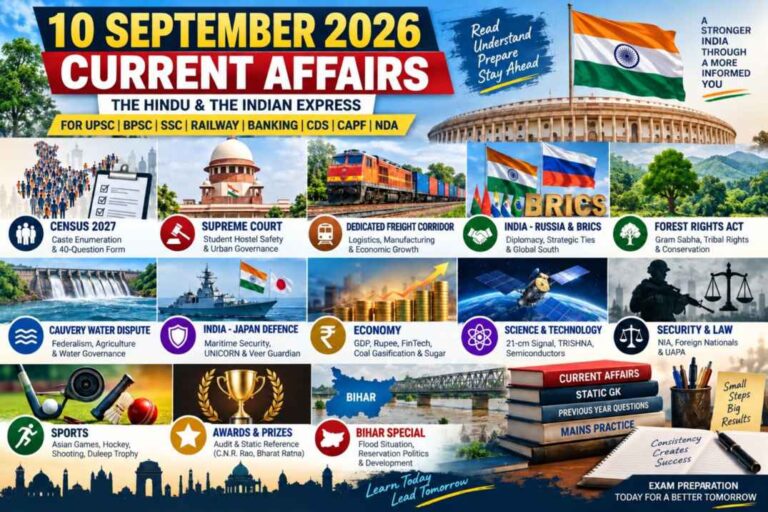
10 September 2026 Current Affairs | The Hindu & Indian Express | UPSC, BPSC, SSC
10 September 2026 Current Affairs from The Hindu & Indian Express covering Iran-US tensions, Hormuz, Ladakh Article 371,...
Read More →
10 September 2026 Current Affairs: Census 2027, DFC, BRICS, सुप्रीम कोर्ट, अर्थव्यवस्था, रक्षा, बिहार और Sports
10 सितंबर 2026 The Hindu और The Indian Express आधारित व्यापक हिंदी Current Affairs Class: Census 2027, DFC,...
Read More →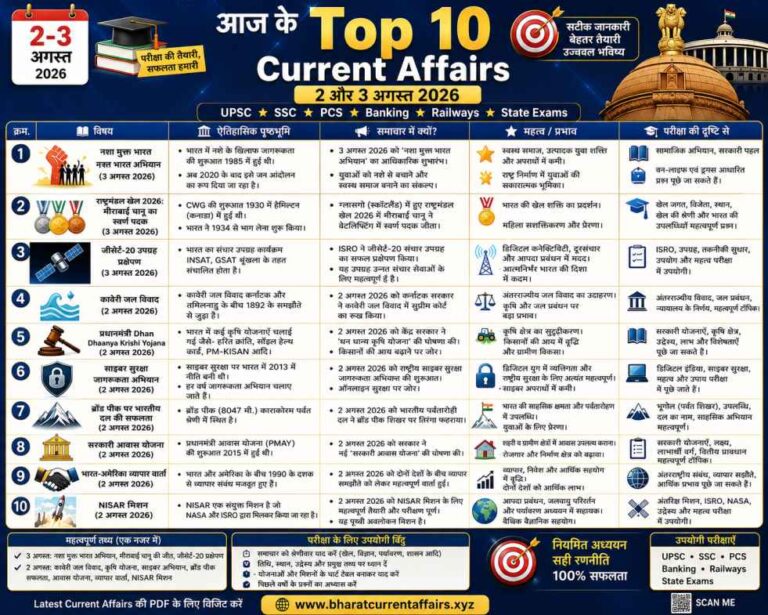
2-3 August 2026 Daily Current Affairs
2–3 अगस्त 2026 के Top 10 Current Affairs हिंदी में पढ़ें। UPSC, SSC, Banking, Railway, PCS व अन्य…
Read More →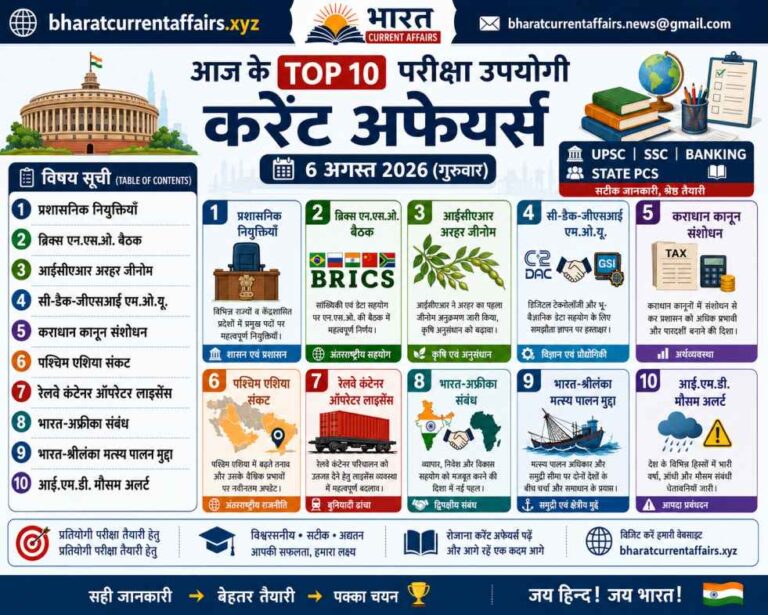
6 August 2026 Daily Current Affairs
Headline News for August 6, 2026: Key updates on new Cabinet Secretary TV Somanathan, BRICS NSO meeting, Critical…
Read More →
BRICS 2026: India Chairship, Members & Geopolitics
BRICS 2026 की India Chairship, 11 सदस्य, expansion, NDB, de-dollarisation, Global South और West Asia geopolitics की पूरी…
Read More →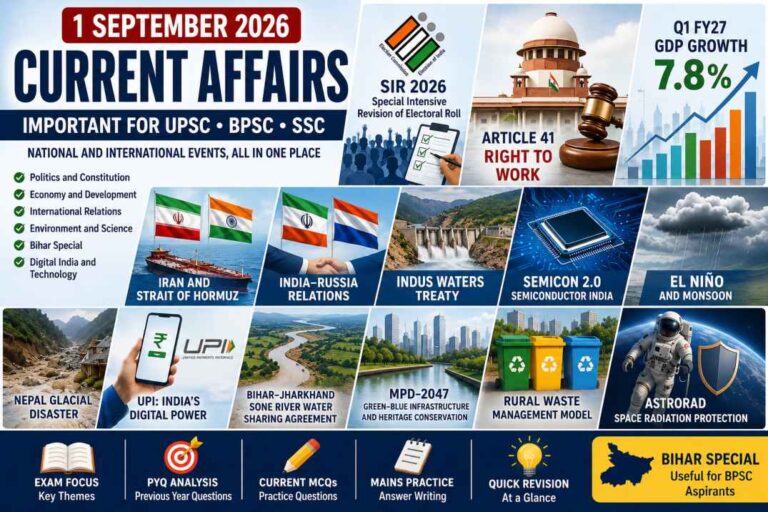
1 September 2026 Current Affairs: UPSC, BPSC & SSC
Read 1 September 2026 Current Affairs for UPSC, BPSC and SSC: SIR, GDP growth, Iran-Hormuz, IWT, Semicon 2.0,…
Read More →