Today’s Top Current Affairs in English
22 and 23 August 2026
Comprehensive analysis of current affairs based on The Hindu — for UPSC, BPSC, SSC, Railway and other competitive examinations
📚 Table of Contents
- India–Japan Maritime Security Cooperation: MoA
- India’s BRICS Presidency 2026: Science, Technology and Innovation Cooperation
- Mirza Fakhrul Islam Alamgir: 23rd President of Bangladesh
- Supreme Court: Legal Practice Requirement for Judicial Service Reduced from 3 Years to 1 Year
- Supreme Court’s Important Judgment on the Definition of ‘Industry’
- Cauvery Water Stress and Weak Monsoon
- INS Mangrol: Anti-Submarine Warfare Shallow Water Craft
- Electronics Component Manufacturing Scheme (ECMS)
- Threat of Oil Spill to Iran’s Hara Mangrove Forests
- U.S. Allegations Regarding Transshipment of Chinese Goods Through India
- Practice MCQs
- Official Sources and Further Reading
📌 Introduction
Around 22 and 23 August 2026, several national and international developments remained in focus that are directly related to India’s foreign policy, defence, judiciary, economy, environment, water resources and global trade.
From the perspective of competitive examinations, it is not sufficient to remember Current Affairs merely as isolated events. It is essential to understand the historical background, constitutional or legal basis, institutions involved, geographical context, economic implications and significance for India behind every important event.
Keeping this approach in mind, this article explains 10 major topics with Historical Background + Why in News + Key Facts + Significance + Exam Preparation Angle.
🇮🇳🇯🇵 India–Japan Maritime Security Cooperation MoA
Historical Background
India and Japan have transformed their relationship from economic cooperation into a broader strategic and security partnership. In 2014, the two countries elevated their relationship to the level of a Special Strategic and Global Partnership.
India is an important maritime power in the Indian Ocean region, while Japan is a major maritime power in the Western Pacific. For both countries, sea routes, energy supplies, the security of commercial shipping and a rules-based international order are extremely important.
The two countries have already been conducting military exercises such as Dharma Guardian (Army), JAIMEX (Navy) and Veer Guardian (Air Force).
Why in News?
On 20 August 2026, India’s Defence Minister Rajnath Singh and Japan’s Defence Minister Shinjiro Koizumi held a meeting in New Delhi and signed a Memorandum of Arrangement (MoA) on Maritime Security Cooperation.
Key Facts
The major areas covered under the MoA include:
- Maritime Domain Awareness (MDA)
- Maritime information sharing
- Search and Rescue (SAR)
- Humanitarian Assistance and Disaster Relief (HADR)
- Security of Sea Lines of Communication (SLOCs)
- Mutual visits of naval ships and units
- Joint military exercises
- Personnel and Subject Matter Expert exchanges
- Logistical support and port facilities
- Maintenance and ship-repair cooperation
- Mine countermeasure capabilities
- Potential cooperation in naval shipbuilding and design
Both countries also emphasized expanding cooperation in defence shipbuilding by combining Japan’s technological capabilities with India’s production capacity.
The UNICORN integrated communications antenna system is particularly important in India–Japan defence technology cooperation. It has been described as the first major defence equipment transfer project between the two countries.
Importance and Examination Relevance
- Important for Indo-Pacific and maritime security.
- Related to India’s Act East Policy and Indo-Pacific approach.
- Useful for understanding the concept of Maritime Domain Awareness.
- Linked with defence manufacturing and Make in India.
- Highlights the growing strategic importance of India–Japan relations within the Quad.
🌐 India’s BRICS Presidency 2026: Innovation and Technology Cooperation
Historical Background
BRICS originally emerged as a grouping of Brazil, Russia, India and China, with the first BRIC Summit being held in 2009. After South Africa joined, the group became BRICS in 2011. The expansion of the grouping from 2024 onwards further increased its membership and global influence.
India is chairing BRICS in 2026 and has adopted “Building for Resilience, Innovation, Cooperation and Sustainability” as the theme of its chairship.
Why in News?
On 22 August 2026, the 14th BRICS Science Ministerial Meeting concluded in Chennai with the unanimous adoption of the Chennai Declaration.
Key Facts
- The meeting was chaired by India.
- The Chennai Declaration provides a framework for cooperation in science, technology and innovation.
- Emphasis was placed on a people-centred and humanity-first approach.
- Cooperation in Artificial Intelligence.
- High Performance Computing.
- Quantum Technologies.
- Biotechnology and healthcare.
- Advanced materials and nanotechnology.
- Photonics and geospatial technologies.
- Renewable energy.
- Ocean and polar sciences.
- Disaster management.
- Climate and sustainability.
The meeting also emphasized advancing the BRICS Global Research Advanced Infrastructure Network (BRICS GRAIN) and expanding access to shared research infrastructure.
The BRICS Science and Research Repository is also being developed as a digital repository for research outputs, datasets and institutional capabilities.
The idea of a BRICS Startup Innovation Fund is also under discussion. For examination purposes, it should be understood as a proposed or under-consideration initiative rather than an immediately implemented financial arrangement.
Importance
- Strengthening scientific cooperation in the Global South.
- Cooperation in frontier technologies such as AI and quantum technology.
- Greater access to shared research infrastructure.
- Mobility of young scientists and innovators.
- Making access to technology more inclusive.
🇧🇩 Mirza Fakhrul Islam Alamgir Becomes the 23rd President of Bangladesh
Historical Background
Bangladesh is a parliamentary republic in which the President is the Head of State, while the Prime Minister is the Head of Government. Therefore, the office of the President is primarily constitutional and ceremonial in nature, although the office retains constitutional importance as the Supreme Commander of the Armed Forces.
Following the political upheaval of 2024, major changes took place in Bangladesh’s political landscape. In 2026, a new political arrangement emerged under a BNP-led government.
Why in News?
On 20 August 2026, the Parliament of Bangladesh elected Mirza Fakhrul Islam Alamgir as President. He received 255 votes, while his rival Oli Ahmed received 88 votes.
On 21 August 2026, he took the oath of office at Bangabhaban in Dhaka and became the 23rd President of Bangladesh.
Key Facts
This presidential election is particularly significant because it was a multi-candidate contested presidential election after 1991.
Importance for India
- India–Bangladesh bilateral relations.
- Border management and border security.
- Management of the Ganga and other shared rivers.
- Trade and connectivity.
- Connectivity with India’s Northeast.
- Bay of Bengal maritime security.
- Energy and regional connectivity.
⚖️ Legal Practice Requirement in Judicial Service: Reduced from 3 Years to 1 Year
Background
There has been a long-standing debate over the practical courtroom exposure required by law graduates before appointment to entry-level posts such as Civil Judge (Junior Division) in the subordinate judiciary.
In May 2025, the Supreme Court had made prior legal practice mandatory for entry-level judicial service. Subsequently, a review of the arrangement was sought.
Why in News?
On 21 August 2026, the Supreme Court reduced the previously prescribed 3-year legal practice requirement to 1 year.
New Arrangement
- One year of legal practice experience for entry-level judicial service.
- One year of intensive judicial academy training after selection.
- One year of structured clerkship thereafter.
- Clerkship exposure with a district judge/higher judicial service judge.
- Structured exposure with a sitting High Court judge as well.
Importance
The decision seeks to balance two competing objectives: on one hand, practical legal experience before entering judicial service, and on the other hand, quicker access to judicial service for young law graduates.
Important for Examinations
- Judicial Service Examination.
- Lower Judiciary reforms.
- Judicial training.
- State Judiciary framework under Articles 233–237.
- Relationship between High Courts and subordinate judiciary.
⚖️ Supreme Court’s Landmark Judgment on the Definition of ‘Industry’
Historical Background
In 1978, a seven-judge Bench in Bangalore Water Supply and Sewerage Board v. R. Rajappa gave a broad interpretation of the term ‘industry’ under Section 2(j) of the Industrial Disputes Act, 1947.
The judgment led to the development of the so-called Triple Test. Because of the broad interpretation, several institutions such as hospitals, educational institutions and welfare activities could potentially come within the industrial dispute framework.
Why in News?
On 20 August 2026, a nine-judge Constitution Bench of the Supreme Court delivered its decision on the reference concerning the old judgment.
By a 6:3 majority, the Court accepted the maintainability of the reference and considered the need for refinement of the broad interpretation in the Bangalore Water Supply judgment.
Key Facts
- Original case: Bangalore Water Supply v. R. Rajappa
- Original judgment: 1978
- Original Bench: 7 judges
- 2026 Reference: 9-judge Constitution Bench
- 2026 Outcome: 6:3 majority
- The present decision primarily concerns Section 2(j) of the repealed Industrial Disputes Act.
- The new definition under the Industrial Relations Code was not redefined through this judgment.
Why Important for Examinations?
The case is extremely important for understanding judicial precedent, Constitution Benches, labour law reform, the Industrial Relations Code and the distinction between the old and new labour law frameworks.
💧 Cauvery Water Stress and Weak Monsoon
Historical Background
The Cauvery is one of the major interstate rivers of southern India. Its basin is primarily spread across Karnataka and Tamil Nadu, while its waters are also relevant to Kerala and Puducherry.
The core issue in the Cauvery water dispute is the sharing of river water and the competing requirements of basin states. Following the Supreme Court’s 2018 judgment, the institutional roles of the Cauvery Water Management Authority (CWMA) and Cauvery Water Regulation Committee (CWRC) became important.
Why in News?
Weak monsoon conditions and lower inflows into basin reservoirs increased water-related tensions between Karnataka and Tamil Nadu.
On 11 August 2026, the CWMA directed Karnataka to release water to Billigundlu at a rate of 12,000 cusecs per day for 15 days.
Important Facts
Karnataka cited hydrological distress and deficient monsoon conditions while expressing concern over water availability. According to available figures, inflows into four major reservoirs were reported to be around 47 percent below the 30-year average.
Importance
- Inter-State River Water Disputes.
- Water Federalism.
- Climate change and rainfall variability.
- Agriculture and drinking water security.
- Tribunal and Supreme Court decisions.
- Role of CWMA and CWRC.
🚢 INS Mangrol: Anti-Submarine Warfare Shallow Water Craft
Background
India has placed strong emphasis on indigenous naval shipbuilding in recent years. The objective is to reduce dependence on foreign suppliers, strengthen domestic defence manufacturing and enhance the Indian Navy’s underwater surveillance and coastal security capabilities.
The Mahe-class Anti-Submarine Warfare Shallow Water Craft being built by Cochin Shipyard Limited (CSL) is an important project in this direction.
Why in News?
In August 2026, Cochin Shipyard Limited delivered Mangrol to the Indian Navy. It is the third Anti-Submarine Warfare Shallow Water Craft of the project.
Key Facts
These vessels are primarily designed for Anti-Submarine Warfare operations in coastal waters. They are also intended for roles such as Low Intensity Maritime Operations and Mine Laying Operations.
The use of indigenous underwater sensors is an important feature of this class.
Importance
- Indian coastal security.
- Detection capability against enemy submarines.
- Underwater domain awareness.
- Aatmanirbhar Bharat in Defence.
- Indian shipbuilding ecosystem.
- Foundation for defence exports and indigenous technology.
💻 Electronics Component Manufacturing Scheme (ECMS)
Historical Background
Electronics manufacturing in India has grown rapidly, but compared with assembly, import dependence in components and sub-components has remained a major challenge for a long time.
To reduce this value-chain gap, the government notified the Electronics Component Manufacturing Scheme (ECMS) on 8 April 2025.
Why in News?
On 17 August 2026, MeitY approved 31 new proposals under ECMS. With these approvals, the total number of approved applications reached 106.
Key Features of the Scheme
The scheme provides different forms of support depending on the circumstances, including turnover-linked incentive, capital incentive and hybrid incentive. Employment generation is also incorporated into the incentive structure.
Status as of 17 August 2026
| Indicator | Status |
|---|---|
| Total approved projects | 106 |
| Total approved investment | ₹69,548 crore |
| Projected production | ₹5,34,101 crore |
| Direct employment | 74,628 |
| Plants that have started production | 38 |
| Advanced construction / machinery stage | 16 |
The new approvals include components related to camera modules, display modules, optical transceivers, connectors, relays, transducers, filters, capacitors, coils, antennas, enclosures, rare-earth permanent magnets and Li-ion battery supply chains.
Importance
- Moving the electronics value chain from assembly to components.
- Reducing import dependence.
- Increasing domestic value addition.
- Employment generation.
- Atmanirbhar Bharat.
- Supporting the semiconductor and electronics ecosystem.
🌱 Threat of Oil Spill to Iran’s Hara Mangrove Forests
Historical and Geographical Background
The Hara mangrove forests are an important coastal ecosystem located around Qeshm Island and the Khuran Strait in Iran’s Persian Gulf region.
The ecosystem primarily consists of Avicennia marina, also known as the Grey Mangrove. This species has special adaptations that allow it to survive in saline environments.
Why in News?
An oil spill near southern Qeshm Island created a serious environmental threat to the Hara mangrove ecosystem. The Hindu’s reporting highlighted the spill and difficulties associated with cleanup in a conflict-affected setting.
Key Facts
- Location — Qeshm Island, Iran
- Region — Persian Gulf / Strait of Hormuz region
- Main species — Avicennia marina
- Status — UNESCO Biosphere Reserve
- Importance — fisheries nursery, coastal protection and carbon storage
Mangrove roots help protect coastal areas from erosion. They also provide nursery habitats for marine species such as fish, shrimp and crabs.
The specialized root systems and salt-management adaptations of Avicennia marina allow it to survive in highly saline coastal environments.
Impact of Oil Spill
- Contamination of mangrove roots and sediments.
- Damage to marine nursery habitats.
- Impact on fisheries and local livelihoods.
- Impact on bird habitats.
- Potential reduction in carbon storage capacity.
- Difficulty in long-term recovery of the coastal ecosystem.
Importance for India and Examinations
This is not merely an international environmental issue related to Iran. It is also relevant for India in the context of mangrove conservation, oil-spill response and blue-carbon policy.
🇺🇸🇮🇳🇨🇳 U.S. Allegations Regarding Transshipment of Chinese Goods Through India
Background
Transshipment generally means routing goods through a third country or jurisdiction before they reach their final destination. This practice is not inherently illegal.
The problem arises when the actual country of origin of goods is concealed through relabelling, repackaging, minor processing or false documentation in an attempt to avoid tariffs or other trade remedies.
Why in News?
The U.S. White House Office of Trade and Manufacturing Policy released a report titled “The Great Transshipment Scam: Rise, Scope, and Costs” in August 2026.
On 23 August, The Hindu analysed the U.S. allegations concerning India and their possible economic implications based on the report.
Major Claims of the U.S. Report
- More than 40 countries/jurisdictions were associated with elevated transshipment risk.
- India was placed in the high-risk / Tier-1 group.
- The report discussed third-country routing of China-origin goods.
- Relabelling, repackaging, re-invoicing and limited processing were among the practices discussed.
This figure relates to the combined estimate for the three major hubs. It should not be interpreted as the value of goods transshipped by India alone.
Economic Implications for India
- Origin verification for Indian exporters may increase.
- Customs documentation may become more stringent.
- The importance of Rules of Origin will increase.
- U.S.–India trade negotiations may be affected.
- Indian manufacturing sectors dependent on Chinese inputs may face greater scrutiny.
- A clear distinction between legitimate India-based manufacturing and illegal transshipment will be necessary.
Important Caution
Exam Preparation Angle
This topic is connected with GS Paper III areas such as international trade, Rules of Origin, customs, tariff policy and global supply chains. It is also relevant to the economic dimension of India–U.S. relations under GS Paper II.
⚡ Quick Revision Capsule
| India–Japan | Maritime Security MoA — MDA, SAR, HADR, SLOC, shipbuilding |
| BRICS | Chennai Declaration — STI cooperation, AI, quantum, GRAIN |
| Bangladesh | Mirza Fakhrul Islam Alamgir — 23rd President |
| Judiciary | Entry-level judicial service — practice requirement 3 years → 1 year |
| Industry | 9-judge SC Constitution Bench — 1978 Bangalore Water Supply case |
| Cauvery | Weak monsoon, hydrological distress, CWMA directions |
| INS Mangrol | Mahe-class ASW Shallow Water Craft |
| ECMS | Electronics component ecosystem and domestic value addition |
| Hara Forests | Qeshm Island, Iran — Avicennia marina — UNESCO Biosphere Reserve |
| Transshipment | U.S. report — China-origin goods, India and 40+ jurisdictions |
📝 UPSC/BPSC Pattern MCQs
The following questions are based on each major topic. The questions include a mix of factual, conceptual and statement-based patterns.
1. With reference to the India–Japan Maritime Security Cooperation MoA, which of the following areas are covered?
The MoA includes Maritime Domain Awareness, Search and Rescue, HADR, naval visits, exercises, logistics and information sharing between the Indian Navy and Japan Maritime Self-Defense Force.
2. Which of the following India–Japan exercises is correctly matched?
Dharma Guardian is an Army exercise, JAIMEX is a maritime/naval exercise and Veer Guardian is an Air Force exercise between India and Japan.
3. What is the theme of India’s BRICS Presidency 2026?
The theme of India’s 2026 BRICS Chairship is “Building for Resilience, Innovation, Cooperation and Sustainability”.
4. The Chennai Declaration is related to which of the following?
The Chennai Declaration was adopted at the 14th BRICS Science Ministerial Meeting to strengthen cooperation in Science, Technology and Innovation.
5. Consider the following statements regarding Mirza Fakhrul Islam Alamgir:
Alamgir was elected by Parliament with 255 votes on 20 August and took oath at Bangabhaban on 21 August.
6. Mirza Fakhrul Islam Alamgir belongs to which political party in Bangladesh?
7. According to the Supreme Court’s 2026 judicial service decision, what is the mandatory legal practice requirement for entry-level judicial service?
The Court reduced the earlier three-year requirement to one year and also introduced a training and clerkship framework after selection.
8. What is included in the new arrangement for selected judicial service candidates?
9. The Bangalore Water Supply and Sewerage Board v. R. Rajappa case primarily dealt with the broad interpretation of which concept?
The 1978 seven-judge Bench gave a broad interpretation of ‘industry’ under Section 2(j) of the Industrial Disputes Act.
10. Which statement is correct regarding the 2026 Supreme Court judgment?
This is a very important distinction. The 2026 judgment concerned Section 2(j) of the old Industrial Disputes Act; the new definition under the IR Code was not interpreted through this judgment.
11. Which institutions play important roles in the management of the Cauvery water dispute?
12. In August 2026, at approximately what daily rate did the CWMA direct Karnataka to release water at Billigundlu?
13. INS Mangrol is an example of which type of warship?
14. Which of the following statements about the Mahe-class ASW Shallow Water Craft is correct?
15. When was the Electronics Component Manufacturing Scheme (ECMS) notified?
16. What is the main objective of ECMS?
ECMS focuses on developing electronics components, sub-assemblies, supply-chain products and the capital equipment ecosystem.
17. Hara Mangrove Forests are primarily associated with which species?
18. The Hara mangrove ecosystem is located in which region?
19. Which statement regarding transshipment is correct?
Transshipment can be a normal trade practice. The problem arises when a third country is used to conceal the actual origin of goods or evade tariffs.
20. According to the U.S. report, what was the approximate combined estimate of China-origin goods transshipped through Mexico, India and Vietnam in 2025?
This was the combined estimate for the three major hubs. It should not be interpreted as India’s transshipment value alone.
21. Consider the following pairs:
1. Dharma Guardian — India-Japan Army Exercise
2. JAIMEX — India-Japan Maritime Exercise
3. Veer Guardian — India-Japan Air Exercise
How many of the above are correctly matched?
22. Which of the following are associated with BRICS STI cooperation?
23. Which of the following is NOT a target segment of ECMS?
24. Consider the following statements regarding Hara mangroves:
1. They are associated with the Qeshm Island region of Iran.
2. Avicennia marina is the major mangrove species found here.
3. They help provide coastal protection.
25. Which is the most accurate statement regarding the 2026 Supreme Court ‘Industry’ judgment?
This question is particularly important for UPSC/BPSC. It would be a factual error to directly equate the 2026 judgment with the new definition under the Industrial Relations Code.
🎯 Final Examination Strategy
If you have limited time, revise these topics in the following priority order:
For UPSC/BPSC Prelims, remember dates, institutions, locations, full forms, numbers and constitutional/legal distinctions.
For UPSC/BPSC Mains, do not write only facts. Add background, causes, significance, challenges and way forward to every topic.
🔗 Official Sources and Further Reading
Candidates can use the following sources to access primary information and official documents related to the topics discussed.
- Press Information Bureau (PIB) — Official press releases of the Government of India
- Ministry of Defence — Official information on India–Japan defence cooperation and the Indian Navy
- Ministry of External Affairs — India–Japan and India–Bangladesh relations
- BRICS India 2026 — India’s BRICS 2026 Presidency
- Department of Science & Technology — BRICS Science, Technology and Innovation cooperation
- Ministry of Electronics & Information Technology — Electronics Component Manufacturing Scheme
- ECMS Official Portal — Electronics Component Manufacturing Scheme
- Supreme Court of India — Judicial service and Constitution Bench judgments
- Department of Water Resources, River Development & Ganga Rejuvenation — Information related to water resources and river management
- UNESCO Man and the Biosphere Programme — Official information on Biosphere Reserves
- The White House — U.S. policy and trade reports
- The Hindu — Original newspaper coverage and detailed analysis
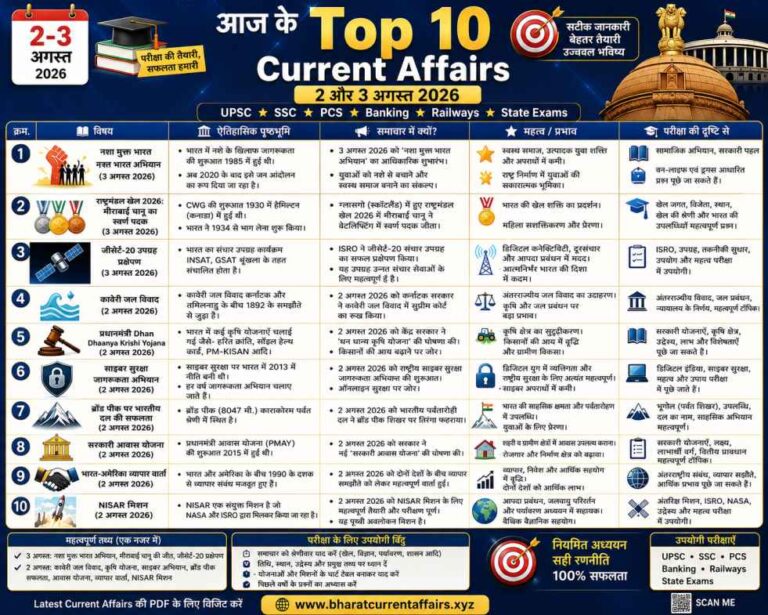
2-3 August 2026 Daily Current Affairs
2–3 अगस्त 2026 के Top 10 Current Affairs हिंदी में पढ़ें। UPSC, SSC, Banking, Railway, PCS व अन्य…
Read More →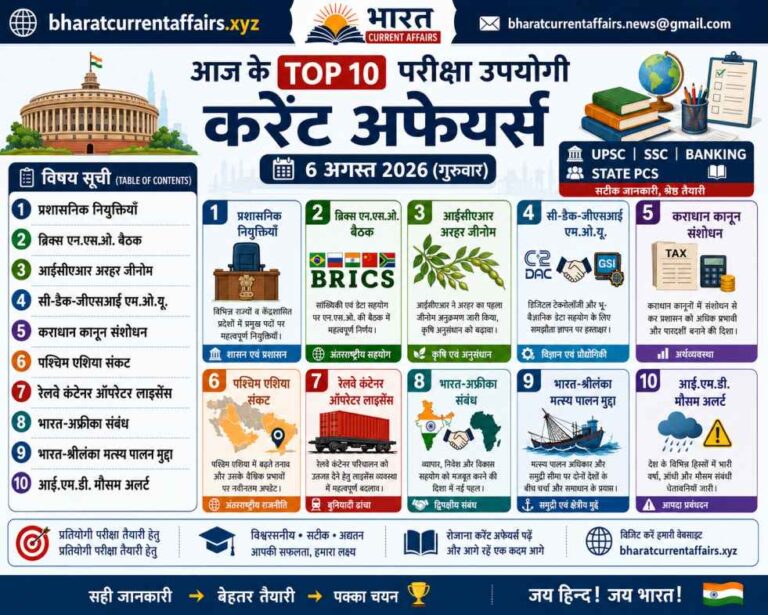
6 August 2026 Daily Current Affairs
Headline News for August 6, 2026: Key updates on new Cabinet Secretary TV Somanathan, BRICS NSO meeting, Critical…
Read More →
BRICS 2026: India Chairship, Members & Geopolitics
BRICS 2026 की India Chairship, 11 सदस्य, expansion, NDB, de-dollarisation, Global South और West Asia geopolitics की पूरी…
Read More →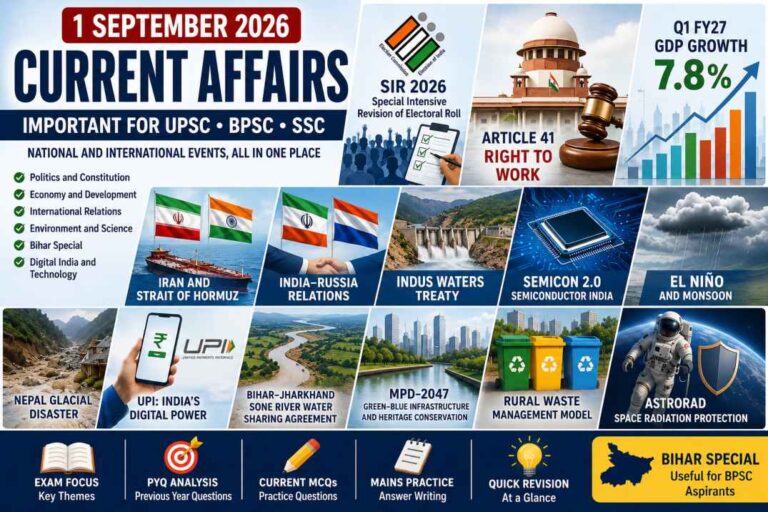
1 September 2026 Current Affairs: UPSC, BPSC & SSC
Read 1 September 2026 Current Affairs for UPSC, BPSC and SSC: SIR, GDP growth, Iran-Hormuz, IWT, Semicon 2.0,…
Read More →