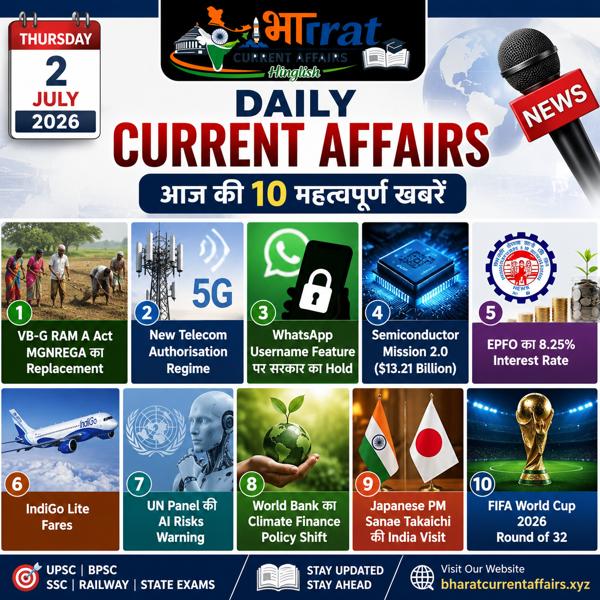
Read the complete Daily Current Affairs for 2 July 2026 covering VB-G RAM G Act, New Telecom Authorisation Regime, WhatsApp Username Feature, Semiconductor Mission 2.0, EPFO 8.25% Interest Rate, AI Risks, Climate Finance, India-Japan relations and FIFA World Cup 2026. Useful for UPSC, BPSC, SSC, Railway, Banking and all competitive exams.
Daily Current Affairs – 2 July 2026
Introduction
The beginning of July 2026 has witnessed several significant developments across governance, technology, economy, international relations, climate policy, and sports. From India’s new rural employment framework replacing MGNREGA to the expansion of the Semiconductor Mission, AI governance concerns, and FIFA World Cup 2026’s historic format, these events are shaping national and global policies.
Understanding these developments is essential not only for staying informed but also for aspirants preparing for UPSC, BPSC, SSC, Railway, Banking, Defence, and State PCS examinations. This article provides a comprehensive yet easy-to-understand explanation of today’s top 10 current affairs.
1. VB-G RAM G Act Replaces MGNREGA
The Government of India has officially implemented the Viksit Bharat – Guarantee for Rozgar and Ajeevika Mission (Gramin) Act, 2025 (VB-G RAM G Act) from 1 July 2026, replacing the Mahatma Gandhi National Rural Employment Guarantee Act (MGNREGA) after nearly two decades.
The new legislation aims to transform rural employment by focusing not only on wage employment but also on sustainable rural infrastructure, water conservation, climate resilience, and livelihood enhancement. Unlike MGNREGA, which guaranteed 100 days of employment, the new Act provides 125 days of guaranteed employment for every eligible rural household.
The government has also strengthened Direct Benefit Transfer (DBT), digital attendance through facial authentication, timely wage payments, improved transparency, childcare facilities at worksites, and unemployment allowance if work is not provided within the stipulated period.
Key Highlights
- Implemented from 1 July 2026
- Replaces MGNREGA
- 125 days of guaranteed employment
- Greater focus on climate-resilient rural assets
- Enhanced transparency through digital governance
2. New Telecom Authorisation Regime Introduced
The Government has introduced the New Telecom Authorisation Regime under the Telecommunications Act to modernize India’s telecom licensing framework.
Instead of the traditional licensing system, telecom operators will now function under an authorization-based model. The objective is to simplify regulations, reduce compliance costs, and encourage investments in next-generation technologies like 5G, 6G, Satellite Communication, Internet of Things (IoT), and Digital Infrastructure.
The reform is expected to improve ease of doing business while strengthening India’s digital economy and connectivity.
Impact
- Faster deployment of telecom services
- Increased private investment
- Better digital infrastructure
- Promotion of innovation
3. Government Puts WhatsApp Username Feature on Hold
Meta-owned WhatsApp was preparing to launch a Username-based identity system that would allow users to communicate without sharing their mobile numbers.
However, the Government has reportedly placed the feature on hold due to concerns related to cybersecurity, law enforcement, digital identity verification, and national security.
Authorities believe anonymous usernames may complicate criminal investigations and cybercrime tracking. The feature is expected to be reviewed only after adequate safety mechanisms are incorporated.
Why It Matters
- Balancing privacy with security
- Digital governance
- Cybercrime investigations
- Data protection
4. Semiconductor Mission 2.0 Approved
India has approved Semiconductor Mission 2.0, valued at approximately US$13.21 billion, to accelerate domestic semiconductor manufacturing.
Semiconductors are the backbone of modern technologies including smartphones, Artificial Intelligence, electric vehicles, defence equipment, data centres, medical electronics, and advanced computing.
The mission aims to establish fabrication plants, chip packaging units, semiconductor design ecosystems, research centres, and skilled manpower development to reduce India’s dependence on imports.
Major Benefits
- Boost to Make in India
- High-value manufacturing
- Employment generation
- Stronger electronics exports
- Reduced import dependence
5. EPFO Retains 8.25% Interest Rate
The Government has approved an 8.25% interest rate for Employees’ Provident Fund (EPF) deposits for FY 2025–26.
The Employees’ Provident Fund Organisation (EPFO) manages retirement savings for millions of salaried employees. Maintaining this interest rate provides financial stability and strengthens long-term retirement planning.
The decision is expected to benefit crores of subscribers across both public and private sectors.
Key Points
- 8.25% annual interest
- Strengthens retirement savings
- Benefits millions of employees
- Supports long-term financial security
6. IndiGo Introduces Lite Fares for Budget Travellers
India’s leading airline IndiGo has launched a new Lite Fare category aimed at passengers who travel with minimal luggage. The initiative is designed to provide a more affordable travel option for customers carrying only cabin baggage, making air travel more economical and flexible.
Under the Lite Fare scheme, passengers are not entitled to checked-in baggage, allowing the airline to optimize operational efficiency while offering lower ticket prices. This pricing model aligns with global low-cost airline practices and caters especially to frequent business travelers, students, and short-distance passengers.
The move reflects the growing trend of personalized airline services, where customers pay only for the services they actually need.
Key Highlights
- Lower airfare for light travelers
- Cabin baggage only
- Ideal for short domestic trips
- Enhances affordability in the aviation sector
7. UN Panel Warns About Growing Risks of Artificial Intelligence
A United Nations (UN) expert panel has issued a strong warning regarding the rapid expansion of Artificial Intelligence (AI), emphasizing the urgent need for global governance and regulatory frameworks.
While AI is transforming sectors such as healthcare, education, agriculture, finance, and public administration, the report highlights several emerging risks, including misinformation, deepfake technology, cybercrime, algorithmic bias, privacy violations, and autonomous weapons.
The panel recommends international cooperation to establish transparent, ethical, and accountable AI systems that protect human rights while promoting innovation.
Why It Is Important
- Prevent misuse of AI technologies
- Strengthen global AI governance
- Protect privacy and human rights
- Promote ethical AI development
Exam Relevance
- Artificial Intelligence
- Emerging Technologies
- Cyber Security
- Digital Ethics
- Global Governance
8. World Bank Announces Climate Finance Policy Shift
The World Bank has announced a major shift in its climate finance strategy by increasing support for developing countries to tackle climate change through sustainable investments.
The revised policy prioritizes funding for renewable energy, green infrastructure, sustainable agriculture, disaster resilience, water conservation, and climate adaptation projects.
For countries like India, the policy offers significant opportunities to accelerate clean energy transitions, improve climate resilience, and achieve long-term sustainable development goals.
Impact on India
- Increased investment in renewable energy
- Better climate adaptation projects
- Support for green infrastructure
- Progress toward Net Zero targets
- Strengthening sustainable development
9. Japanese Prime Minister Sanae Takaichi Visits India
Japanese Prime Minister Sanae Takaichi visited India to strengthen bilateral cooperation across strategic sectors including semiconductors, defence, supply chains, clean energy, infrastructure, and advanced technology.
India and Japan continue to deepen their Special Strategic and Global Partnership, with both nations emphasizing a free, open, and inclusive Indo-Pacific region.
The visit also focused on expanding investments, technological collaboration, resilient supply chains, and defence partnerships, reinforcing both countries’ shared commitment to regional stability and economic growth.
Major Outcomes
- Expansion of semiconductor cooperation
- Stronger defence collaboration
- Clean energy partnerships
- Supply chain resilience
- Increased Japanese investment in India
Exam Perspective
- India–Japan Relations
- Indo-Pacific Strategy
- Quad Cooperation
- Foreign Policy
10. FIFA World Cup 2026 Introduces Historic Round of 32
The FIFA World Cup 2026 marks a historic milestone as it becomes the first tournament to feature 48 participating teams, replacing the previous 32-team format.
Due to this expansion, FIFA has introduced the Round of 32 knockout stage for the first time in World Cup history. The tournament, jointly hosted by the United States, Canada, and Mexico, will feature 104 matches, making it the largest FIFA World Cup ever organized.
The new format aims to provide more nations with an opportunity to compete on football’s biggest stage while increasing global participation and commercial growth.
Key Highlights
- First World Cup with 48 teams
- First-ever Round of 32
- Hosted by USA, Canada, and Mexico
- Total of 104 matches
Key Takeaways
| Topic | Key Fact |
|---|---|
| VB-G RAM G Act | Replaces MGNREGA with 125 days of employment |
| Telecom Regime | Authorization-based telecom framework |
| WhatsApp Feature | Username rollout paused over security concerns |
| Semiconductor Mission 2.0 | US$13.21 Billion investment |
| EPFO | 8.25% interest rate retained |
| IndiGo Lite | Budget airfare with cabin baggage only |
| UN AI Warning | Calls for global AI governance |
| World Bank | Expanded Climate Finance support |
| Japan Visit | Semiconductor and defence cooperation |
| FIFA World Cup | 48 teams and new Round of 32 |
Conclusion
The developments of 2 July 2026 reflect India’s continued focus on economic reforms, technological advancement, digital governance, social security, and international cooperation. From the implementation of the VB-G RAM G Act to the expansion of Semiconductor Mission 2.0, and from AI governance to climate finance, these developments are shaping the future of India’s economy and its global engagement.
For aspirants preparing for UPSC, BPSC, SSC, Railway, Banking, CDS, NDA, CAPF, and State PCS examinations, these topics are highly significant from both the Preliminary and Main examination perspectives. Staying updated with such current affairs not only strengthens general awareness but also enhances analytical understanding of national and international issues.
Frequently Asked Questions (FAQs)
Q1. Which scheme replaced MGNREGA in July 2026?
Answer: The VB-G RAM G Act (Viksit Bharat – Guarantee for Rozgar and Ajeevika Mission – Gramin) replaced MGNREGA and guarantees 125 days of employment for eligible rural households.
Q2. What is Semiconductor Mission 2.0?
Answer: It is India’s US$13.21 billion initiative to promote domestic semiconductor manufacturing, chip design, packaging, and electronics self-reliance.
Q3. Why did the Government pause WhatsApp’s Username feature?
Answer: Due to concerns related to cybersecurity, law enforcement, user identification, and national security.
Q4. What is the EPFO interest rate for FY 2025–26?
Answer: The Government approved an 8.25% annual interest rate for EPF deposits.
Q5. Why is the FIFA World Cup 2026 historic?
Answer: It will feature 48 teams, 104 matches, and introduce the Round of 32 for the first time.
Published by: Bharat Current Affairs
Category: Daily Current Affairs | National & International Affairs | Competitive Exam Preparation