Current Affairs Comprehensive Analysis
Premium Study Material Specially Designed for Competitive Examinations (UPSC, State PSC, SSC, Bank)
Table of Contents
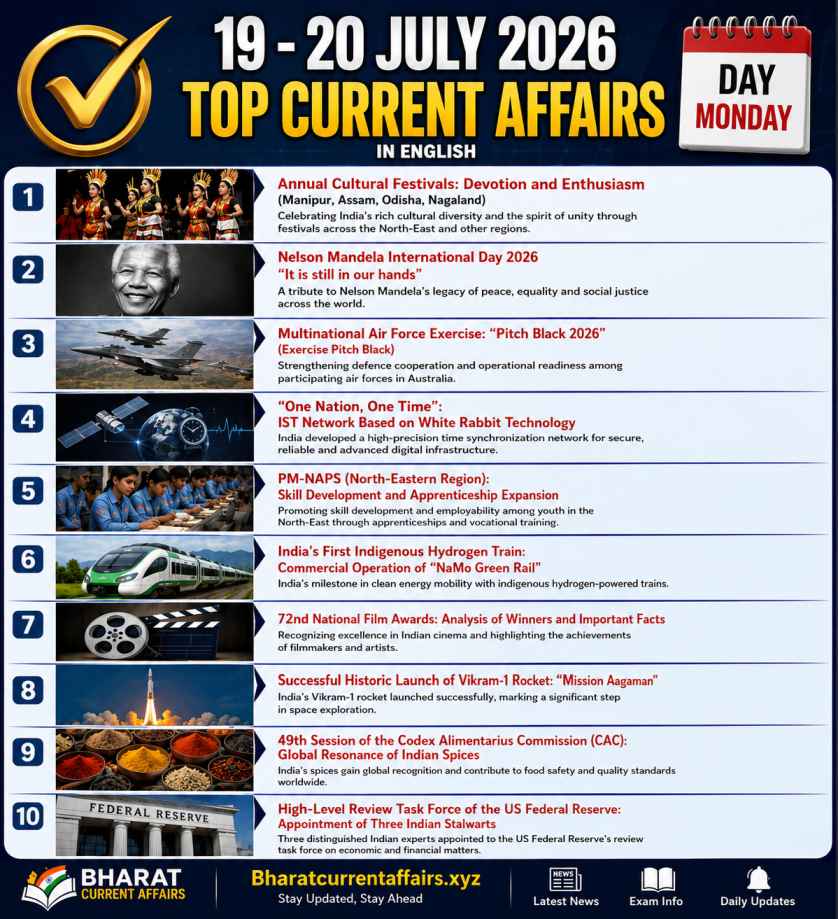
- Annual Cultural Festivals: Devotion and Enthusiasm (Manipur, Assam, Odisha, Nagaland)
- Nelson Mandela International Day 2026: “It is still in our hands”
- Multinational Air Force Exercise: “Pitch Black 2026” (Exercise Pitch Black)
- “One Nation, One Time”: IST Network Based on White Rabbit Technology
- PM-NAPS (North-Eastern Region): Skill Development and Apprenticeship Expansion
- India’s First Indigenous Hydrogen Train: Commercial Operation of “NaMo Green Rail”
- 72nd National Film Awards: Analysis of Winners and Important Facts
- Successful Historic Launch of Vikram-1 Rocket: “Mission Aagaman”
- 49th Session of the Codex Alimentarius Commission (CAC): Global Resonance of Indian Spices
- High-Level Review Task Force of the US Federal Reserve: Appointment of Three Indian Stalwarts
1. Annual Cultural Festivals: Devotion and Enthusiasm (Manipur, Assam, Odisha, Nagaland)
Introduction & Current Scenario
Recently, traditional and regional annual festivals have been celebrated across various states of India with immense devotion and enthusiasm. Prominent among these are Manipur’s ‘Kang Chingba’ festival, Assam’s famous ‘Kamakhya Utsav/Ambubachi Mela’, Odisha’s world-renowned ‘Jagannath Rath Yatra’, and Nagaland’s ‘Orange Festival’. These festivals serve as vibrant examples of India’s cultural diversity, folk faith, and agro-tourism.
Historical Background
- Jagannath Rath Yatra (Odisha): Its history is ancient, finding mention in the Skanda Purana and Brahma Purana. This yatra symbolizes the annual journey of Lord Jagannath, his brother Balabhadra, and sister Subhadra from Puri to their aunt’s house (Gundicha Temple).
- Ambubachi Mela (Assam): This fair has been organized for centuries at the Kamakhya Devi Temple located on the Nilachal Hills of Guwahati. It celebrates the annual menstruation cycle of Goddess Kamakhya and the fertility of the Earth, deeply rooted in ancient Tantric traditions.
- Kang Chingba (Manipur): This is the chariot festival of Manipur, which gained popularity in the 18th century during the reign of King Gambhir Singh following the influence of Vaishnavism. It is celebrated in a manner identical to the Puri Rath Yatra.
- Orange Festival (Nagaland): This is a modern socio-cultural and agricultural festival organized in Rüsoma village, Nagaland, aiming to promote local organic orange growers and develop rural tourism.
Connecting Past and Present Context
These religious and cultural festivals, originating in ancient times, are no longer just spiritual centers. In the contemporary era, they have evolved into significant instruments of ‘Soft Diplomacy’, a tourism-based economy, and regional unity. On the other hand, modern events like the Orange Festival demonstrate how cultural frameworks can be leveraged in present times to drive agricultural and economic empowerment.
Festival Detail Table
| Festival Name | Associated State | Key Facts / Exam-Oriented Details |
|---|---|---|
| Kang Chingba | Manipur | Chariot festival celebrated by the Manipuri Vaishnavite community. |
| Ambubachi Mela / Kamakhya Utsav | Assam (Guwahati) | Tantric festival organized in June/July at the Kamakhya Peeth on Nilachal Hill. |
| Jagannath Rath Yatra | Odisha (Puri) | Grand procession of three chariots (Nandighosha, Taladhwaja, Darpadaliana) to Gundicha Temple. |
| Orange Festival | Nagaland | Festival promoting organic farming, orange production, and rural eco-tourism. |
Potential Exam Questions
- MCQ: The famous ‘Kang Chingba’ festival is traditionally celebrated in which state of India?
- A) Assam
- B) Manipur
- C) Odisha
- D) Nagaland
- Answer: B) Manipur
- Descriptive Question: “Regional festivals and fairs in India not only preserve cultural heritage but also play a critical role in developing the local economy.” Discuss this statement in the context of recently celebrated festivals. (150 words)
2. Nelson Mandela International Day 2026: “It is still in our hands”
Introduction & Current Scenario
Every year on July 18, ‘Nelson Mandela International Day’ is observed globally. For the year 2026, the official theme announced for this day is “It is still in our hands”. This day offers an opportunity to remember the humanitarian works, peace initiatives, and freedom struggle of South Africa’s former President and anti-apartheid revolutionary, Nelson Mandela.
Historical Background
Nelson Mandela led a long, historic struggle against the brutal, anti-Black ‘Apartheid regime’ in South Africa. Consequently, he was sentenced to life imprisonment in 1964 on charges of treason. He spent 27 crucial years of his life in prison, primarily on Robben Island. Following international pressure and internal resistance, he was released in 1990, and in 1994, he was democratically elected as South Africa’s first Black president.
India Link & Connecting Context
Mandela’s philosophy was deeply inspired by Mahatma Gandhi’s principles of non-violence and Satyagraha, which is why he is fondly called the ‘Gandhi of South Africa’. The historic ties between India and Mandela are highlighted by the fact that the Government of India conferred the country’s highest civilian honor, the ‘Bharat Ratna’, upon him in the very year of his release from prison, 1990. He was the first full non-citizen to receive this honor. Additionally, Pakistan honored him with its highest civilian award, ‘Nishan-e-Pakistan’, in 1992. He was awarded the ‘Nobel Peace Prize’ in 1993 for global peace. The United Nations General Assembly (UNGA) officially declared this day in November 2009, and the first Mandela Day was celebrated on July 18, 2010.
Key Milestone Facts
- 1964: Sentenced to life imprisonment
- 1990: Released from prison and awarded the ‘Bharat Ratna’ by the Government of India
- 1992: Honored with ‘Nishan-e-Pakistan’
- 1993: Awarded the Nobel Peace Prize
- 2009/2010: Recognized as an International Day by the United Nations General Assembly (UNGA)
Potential Exam Questions
- MCQ: In which year was Nelson Mandela honored with the country’s highest civilian award ‘Bharat Ratna’ by the Government of India?
- A) 1993
- B) 1990
- C) 1994
- D) 2000
- Answer: B) 1990
3. Multinational Air Force Exercise “Pitch Black 2026”
Introduction & Current Scenario
The Indian Air Force (IAF) successfully participated in “Exercise Pitch Black 2026”, a large-scale multinational air combat exercise held in Northern Australia. This is a multinational exercise where premier air forces from across the globe gather to practice complex aerial operations and combat strategies.
Historical Background
Exercise Pitch Black began in 1981 as a bilateral air defense exercise between different squadrons of the Royal Australian Air Force (RAAF). Over time, it expanded into a massive multinational exercise. The Indian Air Force marked its strategic presence by participating in this exercise for the first time in 2018, and India has been a regular participant since then.
Indo-Australia Defence Ties & Connecting Context
Currently, defense relations between India and Australia have strengthened significantly to ensure strategic stability in the Indo-Pacific region. Both nations are members of the ‘QUAD’ security dialogue. Multinational engagements like Pitch Black enhance the interoperability between the two armed forces.
Other Major Military Exercises Between India and Australia
- AUSINDEX: A bilateral exercise conducted between the navies of both countries.
- AUSTRAHIND: An exercise between the armies of both nations (AUSTRAHIND 2025 was held in Perth, Australia).
- Malabar: A naval exercise that includes India and Australia along with other QUAD members (USA and Japan).
Potential Exam Questions
- MCQ: The multinational air force exercise ‘Pitch Black 2026’ was hosted by which country?
- A) India
- B) United States of America
- C) Australia
- D) Japan
- Answer: C) Australia
4. “One Nation, One Time” – IST Network Based on White Rabbit Technology
Introduction & Current Scenario
India has achieved a historic milestone in digital sovereignty and precision timekeeping. Pralhad Joshi, Union Minister for Consumer Affairs, Food and Public Distribution, and New and Renewable Energy, inaugurated the Indian Standard Time (IST) distribution network based on “White Rabbit Technology” on July 16, 2026, at the Regional Reference Standard Laboratory (RRSL) in Bengaluru. This is part of the government’s ambitious “One Nation, One Time” initiative.
Historical Background
Historically, critical infrastructure systems in India, such as banking, telecommunications, stock exchanges, and power grids, relied on foreign satellite systems, primarily the American GPS, for time synchronization. From cybersecurity and national security standpoints, this dependence posed a major risk, as a technical glitch or conflict situation causing the shutdown of external systems could paralyze the country’s digital framework.
Technical Link & Advantages
With the development of this new indigenous system, India’s dependence on foreign sources will be completely eliminated. White Rabbit Technology is a high-precision time synchronization system that distributes time across digital networks with sub-nanosecond accuracy. This time is fully traceable to UTC (NPLI).
Developers & Stakeholders
This network has been jointly developed by the Department of Consumer Affairs, CSIR-National Physical Laboratory (CSIR-NPL), and the Indian Space Research Organisation (ISRO). Stakeholders like SEBI, the National Stock Exchange (NSE), and BSNL were also involved in the validation process.
Key Benefits: Enhanced digital data protection, security against cyberattacks and hardware time-spoofing, and massive improvements in the reliability of financial markets and power grids.
Potential Exam Questions
- MCQ: Which of the following fields is directly related to the recently discussed ‘White Rabbit Technology’?
- A) Cybersecurity Software
- B) Ultra-precise Time Synchronization (IST Network)
- C) Quantum Computing Chip
- D) Artificial Intelligence (AI) Robotics
- Answer: B) Ultra-precise Time Synchronization (IST Network)
- Descriptive Question: “Digital time sovereignty is indispensable for protecting a nation’s sensitive digital infrastructure.” Examine this statement in light of White Rabbit Technology and the ‘One Nation, One Time’ initiative. (250 words)
5. PM-NAPS (North-Eastern Region): Skill Development & Apprenticeship Expansion
Introduction & Current Scenario
The Ministry of Skill Development and Entrepreneurship (MSDE) has made a significant announcement extending the North-Eastern component of the Pradhan Mantri National Apprenticeship Promotion Scheme (PM-NAPS) up to the financial year 2026-27 to reinforce employment and skilling opportunities for youth in the North-Eastern Region (NER). Jayant Chaudhary, Union Minister of State for Skill Development and Entrepreneurship (Independent Charge), is overseeing the implementation of this extended scheme.
Historical Background
The Pradhan Mantri National Apprenticeship Promotion Scheme (PM-NAPS) was launched by the Government of India in August 2016. Its primary objective was to promote apprenticeship training across the nation and bridge the gap between academic knowledge and industrial requirements by offering financial incentives to employers to directly engage youth in on-the-job training.
Connecting Context
The North-Eastern region has historically faced challenges due to difficult geographical terrains and industrial detachment from the mainland. To correct this imbalance, the government has made a special financial allocation of 57.58 crore rupees under PM-NAPS for the North-East for FY 2026-27. Through this special budgetary provision, quality industrial apprenticeship will be provided to over 30,000 (30K) youth in the North-East, strengthening the local ecosystem.
Potential Exam Questions
- MCQ: In which year was the Pradhan Mantri National Apprenticeship Promotion Scheme (PM-NAPS) launched?
- A) 2014
- B) 2016
- C) 2018
- D) 2020
- Answer: B) 2016
6. India’s First Indigenous Hydrogen Train: Commercial Operation of “NaMo Green Rail”
Introduction & Current Scenario
Indian Railways has taken a historic stride toward green energy and zero carbon emissions. Prime Minister Narendra Modi flagged off India’s first indigenously developed hydrogen-powered passenger train, named “NaMo Green Rail”. The train commenced its commercial passenger service on July 19, 2026, over the 89-kilometer-long rail section between Jind and Sonipat in Haryana.
Historical Background
Historically, Indian Railways relied on coal (steam), followed by diesel, and then electric grids. In view of environmental preservation, Germany ran the world’s first hydrogen-powered commercial train in 2018. Under its ‘National Green Hydrogen Mission’, India has set a target for the railways to become a net-zero carbon emitter by 2030, and this project serves as the country’s first successful technology-demonstration pilot.
Technical Specs & Features
The train was designed and manufactured entirely in India by the Integral Coach Factory (ICF), Chennai, while the technical specifications were drafted by the Research Designs and Standards Organisation (RDSO). It operates on ‘Proton Exchange Membrane’ fuel cell technology, where onboard stored hydrogen generates electricity through an electrochemical process combining with oxygen from the air. The only by-product of this process is water vapour and heat, meaning zero smoke or carbon emissions.
Key Technical Data
- Route: Jind-Sonipat rail section, Haryana (Distance: 89 km, Time: 2 hours, Stoppages: 12 stations).
- Structure: A 10-coach trainset comprising 2 hydrogen driving power cars and 8 trailer coaches. Total capacity is approximately 2,600 passengers.
- Safety Clearance: Certified by the Petroleum and Explosives Safety Organisation (PESO) and TÜV SÜD, Germany.
- Additional Fact (Railway Record): Recently, Indian Railways successfully operated its longest freight train, ‘Rudrastra’, running from Gajarkhyaja to Garhwa.
Potential Exam Questions
- MCQ: Commercial operations of India’s first indigenous hydrogen-powered train, “NaMo Green Rail”, commenced between which two stations?
- A) Delhi and Meerut
- B) Jind and Sonipat
- C) Mumbai and Pune
- D) Bengaluru and Mysore
- Answer: B) Jind and Sonipat
7. 72nd National Film Awards: Analysis of Winners & Important Facts
Introduction & Current Scenario
The Ministry of Information and Broadcasting, Government of India, has announced the 72nd National Film Awards in New Delhi for films certified in the year 2024. The National Film Awards stand as the nation’s most prestigious cinematic honor, conferred upon outstanding films that are artistically, technically, and socially relevant.
Historical Background
Established in 1954 as the ‘State Awards for Films’, these honors aimed to promote Indian art and culture. Initially presented across limited categories, the awards expanded over time to include feature films, non-feature films, and best writing on cinema. Currently, these awards are administered by the Directorate of Film Festivals under the Ministry of Information and Broadcasting.
Winners & Facts
Mainstream socio-political and biographical films dominated this year’s awards. Renowned filmmaker Jayraj chaired the feature film jury, while Asim Kumar Sinha headed the non-feature film jury. The details of the major winners are given in the table below:
Category Winner Film Best Feature Film Article 370 Article 370 Best Actor Mammootty Kartik Aaryan Bramayugam Chandu Champion Best Actress Yami Gautam Article 370 Best Director – Feature Rajkumar Periasamy Amaran Best Director – Non-Feature Anand L. Rai Statue of Unity Best Hindi Film Srikanth Srikanth Potential Exam Questions
- MCQ: Which film was awarded ‘Best Feature Film’ at the 72nd National Film Awards?
- A) Chandu Champion
- B) Srikanth
- C) Article 370
- D) Amaran
- Answer: C) Article 370
8. Successful Historic Launch of Vikram-1 Rocket: “Mission Aagaman”
Introduction & Current Scenario
On July 18, 2026, India’s private space sector script a golden chapter in history. Hyderabad-based private space startup Skyroot Aerospace successfully launched its first orbital launch vehicle, “Vikram-1”, from the First Launch Pad at the Satish Dhawan Space Centre, Sriharikota. This historic inaugural flight was codenamed “Mission Aagaman”.
Historical Background
Historically, India’s space program was entirely under the institutional control of the government space agency ISRO. In 2020, the central government announced structural space sector reforms, opening it up to private firms and setting up the ‘IN-SPACe’ regulatory body. Skyroot Aerospace previously launched India’s first private sub-orbital rocket ‘Vikram-S’ in November 2022. Now, the successful launch of ‘Vikram-1’ marks India’s first successful private orbital launch. With this, India becomes the third country in the world (after the US and China) where a private company has independently developed an orbital rocket to deploy satellites into space.
Technical Details
The Vikram-1 rocket is built entirely with an advanced all-carbon-composite structure. It is a multi-stage rocket whose first three stages are powered by solid-fuel engine technology, and it also utilizes 3D-printed liquid engine components. The rocket successfully placed satellites into a Low Earth Orbit (LEO) at an altitude of approximately 450 km.
Key Specifications
- Solid Fuel Stage Architecture: Stage 1: ‘Kalam 1200’, Stage 2: ‘Kalam 1250’, Stage 3: ‘Kalam 100’.
- Payload Capacity: Capable of carrying small satellites weighing up to 350 kilograms (350 kg) to LEO.
- Deployed Satellites: Deployed three miniature satellites (Slope, Solars-S3, and Imbres) via this mission.
- Special Tribute: Housed within the rocket were miniature statues/tributes to three iconic Indian scientists—Dr. Vikram Sarabhai, C.V. Raman, and Dr. A.P.J. Abdul Kalam, alongside an inscribed message from Prime Minister Narendra Modi.
Potential Exam Questions
- MCQ: What was the codename assigned to the first successful orbital launch mission of India’s first private rocket ‘Vikram-1’?
- A) Mission Prarambh
- B) Mission Aagaman
- C) Mission Udaan
- D) Mission Sky
- Answer: B) Mission Aagaman
- Descriptive Question: “The entry of private players into the space sector has positioned India as a competitive force in the global commercial space market.” Critically analyze this statement in reference to Skyroot Aerospace’s ‘Mission Aagaman’. (250 words)
9. 49th Session of the Codex Alimentarius Commission (CAC): Global Resonance of Indian Spices
Introduction & Current Scenario
India achieved an immense diplomatic and trade breakthrough in international food standard formulation during the 49th session of the Codex Alimentarius Commission (CAC) held in Geneva, Switzerland. Drafted under India’s leadership and co-chairmanship, unified global quality standards for three premier spices—Large Cardamom, Coriander, and Vanilla—were adopted by consensus.
Historical Background
The Codex Alimentarius Commission (CAC) was established jointly in 1963 by the Food and Agriculture Organization (FAO) and the World Health Organization (WHO) of the United Nations. Its core mandate is to safeguard consumer health and ensure fair practices in the global food trade. India became a member in 1964. Since its inception in 2014, India has chaired the ‘Codex Committee on Spices and Culinary Herbs’ (CCSCH), with the ‘Spices Board of India’ serving as its secretariat.
Trade Significance & Connecting Context
This approval is a game-changer because India is the world’s largest producer, consumer, and exporter of spices. Large Cardamom is primarily an indigenous crop of the North-Eastern Himalayan region (Sikkim and Darjeeling); establishing global standards for it will enormously benefit local farmers. The World Trade Organization (WTO) recognizes Codex standards as reference benchmarks for resolving international trade disputes. Therefore, as long as Indian spices comply with these standards, no country can reject them as ‘unsafe’ without scientific evidence, safeguarding Indian exports from Non-Tariff Barriers.
Potential Exam Questions
- MCQ: During the recently held 49th session of the Codex Alimentarius Commission (CAC) in Geneva, India-led global quality standards were adopted for which of the following spices?
- A) Black Pepper, Cumin, Turmeric
- B) Large Cardamom, Coriander, Vanilla
- C) Ginger, Fenugreek, Cinnamon
- D) Clove, Nutmeg, Cardamom
- Answer: B) Large Cardamom, Coriander, Vanilla
10. High-Level Review Task Force of the US Federal Reserve: Appointment of Three Indian Stalwarts
Introduction & Current Scenario
Kevin Warsh, the newly appointed Chair of the US Federal Reserve (the central bank of the United States), announced the formation of five independent, high-level Task Forces to conduct a comprehensive review of its monetary policy framework and balance sheet operations. In this global financial restructuring process, it is a matter of immense pride for India that three world-renowned experts of Indian origin have been appointed to these task forces, prominently including former Reserve Bank of India (RBI) Governor Dr. Raghuram Rajan.
Historical Background
Established in 1913, the US Federal Reserve ranks among the most powerful financial institutions globally. During the COVID-19 pandemic, the Federal Reserve resorted to aggressive asset purchases (Quantitative Easing) to support the US economy, expanding its balance sheet to a record high of nearly $9 trillion. Subsequently, inflation in the US has hovered above its long-term target of 2% over the last five years. This extraordinary historical situation and macroeconomic transition necessitated the creation of this review panel.
Role of Indian Experts & Connecting Context
This development mirrors the expanding footprint of Indian intellectual capacity in global policy-making. The roles assigned to the three appointed members are as follows:
- Dr. Raghuram Rajan: Inducted as a member of the ‘Balance Sheet Policy Task Force’. This panel will rigorously dissect the size, composition, and institutional impacts of the Federal Reserve’s massive asset holdings on monetary policy. (Note: Dr. Rajan served as the Governor of the RBI from 2013-16 and was the Chief Economist of the IMF).
- Dr. Raj Chetty: This acclaimed Harvard University economist has been named co-chair of the ‘Data Task Force’, which focuses on upgrading the quality and timeliness of real economic indicators utilized in monetary decisions.
- Asha Sharma: Corporate Vice President at Microsoft and CEO of Xbox, Asha Sharma has been included in the ‘Productivity and Jobs Task Force’, tasked with evaluating how emerging technologies like Artificial Intelligence (AI) will reshape future productivity and long-term economic growth.
Potential Exam Questions
- MCQ: Which former Governor of the Reserve Bank of India (RBI) has been included as a member of the ‘Balance Sheet Policy Task Force’ constituted by the US Federal Reserve?
- A) Dr. Urjit Patel
- B) Dr. Raghuram Rajan
- C) Dr. Y. V. Reddy
- D) Shri Shaktikanta Das
- Answer: B) Dr. Raghuram Rajan
- Descriptive Question: Evaluate the strategic and intellectual significance of the growing participation of experts of Indian origin in global financial regulatory and policy-making bodies. (150 words)